

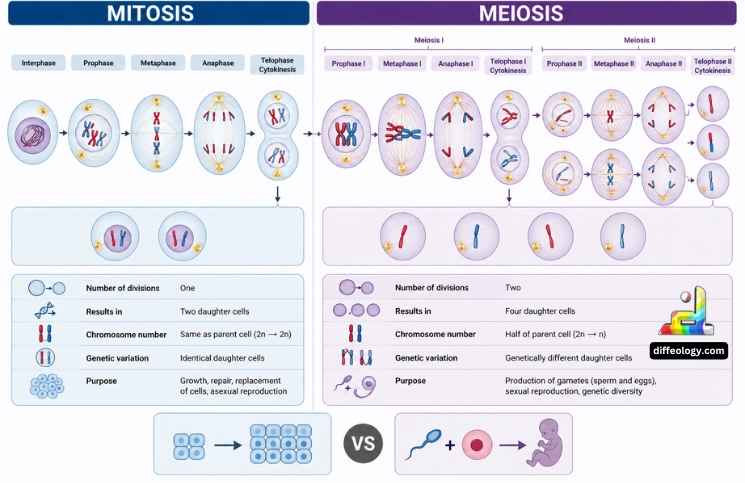
Your body has about 37 trillion cells. Most body cells have 46 chromosomes in 23 pairs. They are involved in the mitosis and meiosis processes.
There is a big difference between mitosis and meiosis that we understand here.
Main Difference Between Mitosis and Meiosis
Cells divide to help the body grow and repair damage. In mitosis, one cell splits once and makes two new cells. Each new human cell has 46 chromosomes.
In meiosis, one cell splits twice to make sperm or eggs. This makes four cells, and each has 23 chromosomes.
So, mitosis keeps the chromosome number the same, while meiosis cuts it in half.
Mitosis Vs. Meiosis
What Is Mitosis?
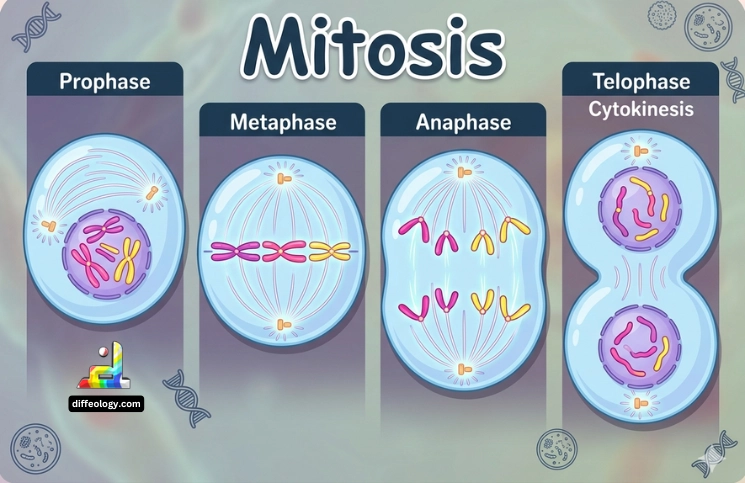
Mitosis means one body cell splits and makes two new body cells. Each new cell gets the same main DNA plan. A skin cell makes more skin cells. A bone cell makes more bone cells. This helps each tissue do its job.
The body uses this process every day. A cut closes when skin cells make more skin cells. A child grows because body cells divide. The gut lining stays fresh because old cells leave and new ones take their place.
Many animal cells can finish the S phase in about 1 hour. The full cell cycle can take longer. The cell must grow, copy DNA, check for errors, and get ready to split.
Read Also: Difference Between Haploid and Diploid
Main Facts About Mitosis
- Main job: growth, healing, and cell replacement
- Parent cell: 1 body cell
- Cell splits: 1
- New cells: 2
- Human result: 46 stays 46
- DNA result: close copy
- Body sites: skin, bone, gut lining, and bone marrow
- Study tools: Light Microscopy, Chromosome Staining, and Time-Lapse Imaging
What Is Meiosis?
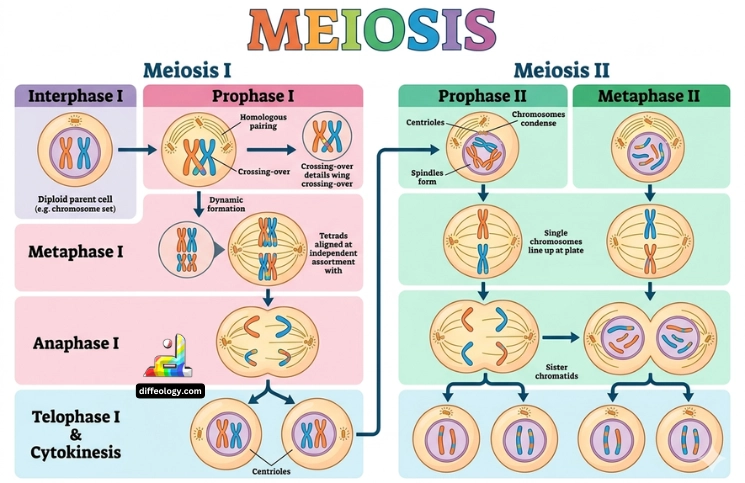
Meiosis means one parent cell in a sex organ divides and makes four sex cells. In males, it helps make sperm. In females, it helps make egg cells. A start cell has 46 chromosomes. Each sex cell ends with 23.
This half count matters. Without it, sperm and egg would join and make too many DNA packs. The number would double in each new generation.
This process also shuffles DNA. Matching DNA packs can swap small parts. They also sort in many ways. In humans, sorting alone can make about 8 million possible mixes before DNA swapping adds more. This is why siblings can share parents but still look different.
Read Also: Difference Between Direct and Indirect Immunofluorescence
Main Facts About Meiosis
- Main job: sperm and egg cell creation
- Parent cell: 1 cell in a sex organ
- Cell splits: 2
- New cells: 4
- Human result: 46 becomes 23
- Drop in number: 50%
- DNA result: new mix
- Life role: reproduction, family traits, and variety
- Study tools: Karyotyping, Flow Cytometry, and DNA Sequencing
Comparison Table “Mitosis Vs. Meiosis”
| Main role | Growth, healing, replacement | Sperm and egg cell creation |
| Cell type | Body cells | Sex cells |
| Splits | 1 | 2 |
| New cells | 2 | 4 |
| Human result | 46 stays 46 | 46 becomes 23 |
| Number change | Same count | 50% drop |
| DNA result | Close copy | New mix |
| Crossing over | Usually no | Yes |
| Healing role | Yes | No |
| Reproduction role | No direct role | Direct role |
| Main site | Body tissues | Sex organs |
| Common tools | Light Microscopy, Chromosome Staining, Time-Lapse Imaging | Karyotyping, Flow Cytometry, DNA Sequencing |
Difference Between Mitosis and Meiosis in Detail
Get to know the Mitosis Vs. Meiosis in Detail.
Body Repair vs New Life
Mitosis helps the body care for itself. It helps a baby grow, a cut heals, and old cells leave the body.
Meiosis helps make new life. It gives sperm and egg cells half the usual DNA pack count. This keeps the count stable when both cells join.
One Split vs Two Splits
Mitosis uses 1 split. The cell copies DNA, lines it up, pulls it apart, and makes two cells.
Meiosis uses 2 splits. One split separates pairs. The next split separates copied parts. This creates four sex cells.
Two Cells vs Four Cells
Mitosis gives 2 daughter cells. These cells keep tissues strong and steady.
Meiosis gives 4 daughter cells. Each one has a fresh gene mix.
Same Count vs Half Count
Mitosis keeps the count the same. In humans, 46 stays 46.
Meiosis cuts the count in half. In humans, 46 becomes 23.
Close Copy vs Fresh Mix
Mitosis makes a close copy of cells. This helps skin stay skin and bone stay bone.
Meiosis makes fresh mixes. Crossing over and random sorting raise variety in children.
Body Tissues vs Sex Organs
Mitosis happens in body tissues such as skin, bone, gut lining, and bone marrow.
Meiosis happens in sex organs. It helps make sperm and egg cells.
Growth Control vs Fertility Health
Mitosis needs tight control. Cells can form tumors when they divide too much or ignore stop signals.
Meiosis needs careful DNA packing. A sex cell with too many or too few packs can harm embryo growth.
Key Difference Between Mitosis and Meiosis
Here are the key points showing the Difference Between Mitosis Vs. Meiosis.
- Division Count: Mitosis has 1 division. Meiosis has 2 divisions. This is one major reason they give different results.
- Final Cell Number: Mitosis makes 2 cells. Meiosis makes 4 cells. This makes meiosis better suited for sex cell formation.
- Chromosome Number: Mitosis keeps the chromosome number the same. Meiosis reduces it by 50%.
- Human Chromosomes: In humans, mitosis keeps 46 chromosomes in each new body cell. Meiosis makes sex cells with 23 chromosomes.
- Main Use: Mitosis is used for growth and repair. Meiosis is used for sexual reproduction.
- Cell Type: Mitosis happens in body cells. Meiosis happens in cells that make sperm and eggs.
- DNA Similarity: Mitosis makes cells that are usually the same. Meiosis makes cells with different DNA mixes.
- Crossing Over: Crossing over usually happens in meiosis. It does not normally happen in mitosis.
- Genetic Variety: Mitosis gives low variety. Meiosis gives high variety because DNA is mixed.
- Parent Cell Match: Mitosis daughter cells match the parent cell. Meiosis daughter cells do not fully match the parent cell.
- Healing Role: Mitosis helps heal cuts and replace old cells. Meiosis does not repair the body.
- Reproduction Role: Meiosis makes sperm and egg cells. Mitosis does not make sex cells.
- Main Technology Used: Light Microscopy can show cell division. Karyotyping can help count chromosomes.
- Life Value: Mitosis keeps the body working. Meiosis helps create new life and genetic variety.
FAQs: Mitosis Vs. Meiosis
Conclusion
The difference between mitosis and meiosis becomes clear when you focus on the job. Every time a cell splits through mitosis, the body adds new tissue, fixes damaged parts and replaces old units. Two fresh cells appear afterward, both holding the usual count – forty-six strings of DNA in people. When meiosis happens instead, the result turns into future sperm or eggs. Four outputs form this way, each one packed with just twenty-three chromosomes for joining later. One keeps body cells stable. The other cuts the count by 50% and creates new trait mixes.
References & External Links
- What is mitosis? – Phases of mitosis – Mitosis stages and cycle
- What is meiosis? – Stages of meiosis with diagram

