

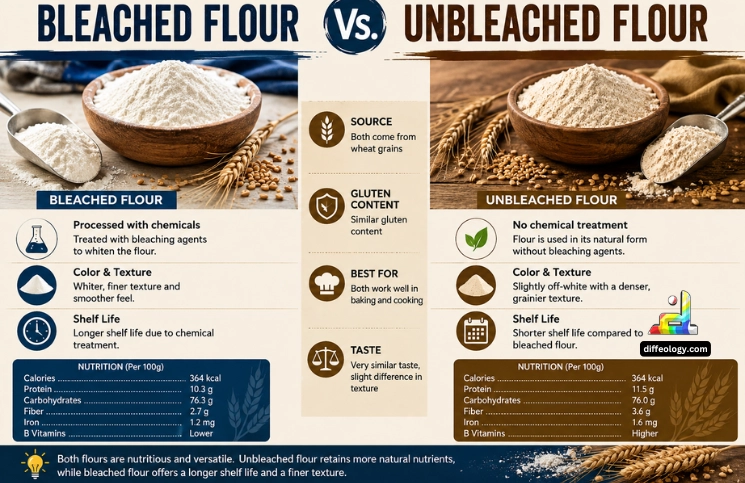
Understanding the difference Between Bleached and Unbleached Flour can feel confusing. In appearance, both types of flour are similar – to identify the distinction, one must examine the processing methods that occur after the milling stage.
Bleached flour is processed to have a white appearance and a texture that is easy to compress. By contrast, unbleached flour undergoes an aging process in the presence of air, which results in a light yellow white color.
Main Difference Between Bleached and Unbleached Flour
As for the primary difference between bleached and unbleached flour, it is the duration and method of aging. Bleached flour involves the use of Chemical Bleaching Technology besides Oxidation Technology to accelerate the aging process. Then again unbleached flour utilizes Natural Aging Technology, which means it ages at a slow rate through exposure to air.
If flour is bleached, the particles are small and have a bright white color. It is a functional option for cakes, pancakes and cookies that require a low level of density – but unbleached flour has a higher level of structural integrity – this quality is useful when bread, pizza dough, rolls and pastry need to maintain a specific form.
Bleached Flour Vs. Unbleached Flour
What is Bleached Flour?
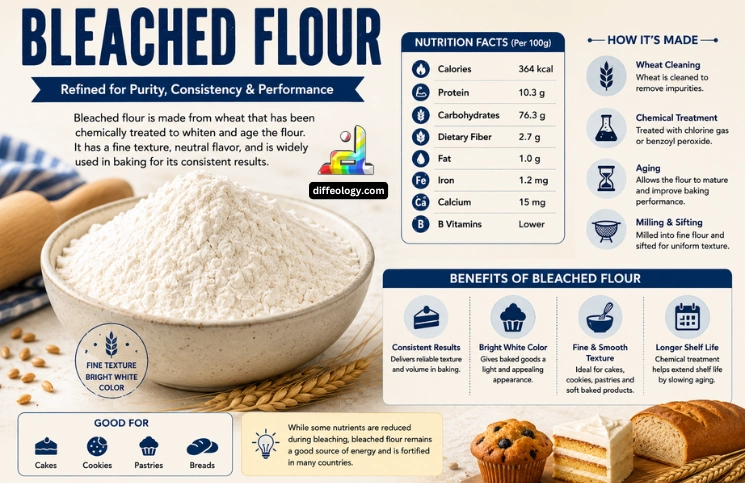
To define bleached flour, it is refined white flour that receives treatment after the wheat is ground. The wheat is processed through Roller Milling Technology or Sifting Technology – those mechanical steps serve to remove the majority of the bran and the germ. Food grade agents like benzoyl peroxide or chlorine dioxide are added to produce a white color and a low resistance texture.
Read Also: Difference Between DayQuil and NyQuil
By using the agents, the manufacturer saves time because the flour does not require a slow aging period. For a baker who intends to produce a soft cake, this efficiency is a practical benefit. And some bleached flour also involves Flour Enrichment Technology, which is the process of returning nutrients to the product. It is possible for enriched flour to contain 2.9 mg of thiamin, 1.8 mg of riboflavin, 24 mg of niacin, 0.7 mg of folic acid and 20 mg of iron per unit.
- Best for cakes, cupcakes, pancakes, waffles, soft cookies, and pie crusts.
- Looks bright white and feels smooth.
- Helps baked foods feel soft and light.
- Often costs less because it ages faster.
- A good choice when a tender bite matters most.
What is Unbleached Flour?
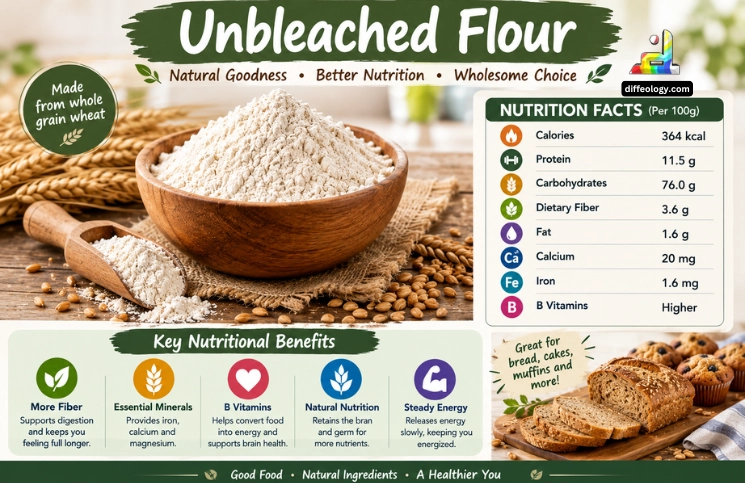
Unbleached flour refers to the refined flour which has not gone through any bleaching process. It is made through the use of Roller Milling Technology and Sifting Technology. The concept behind this flour is straightforward. It allows flour to be naturally aged using the Oxygen available in air. The flour is said to turn cream colored as well as slightly heavier during this aging process.
Read Also:Difference Between Rolaids and Tums
The main reason why many homemakers like using this type of flour is that it appears to them to be very reliable. It may even boost their confidence in baking pizzas as well as bread.
- Best for bread, pizza crust, rolls, biscuits, puff pastry, and choux pastry.
- Has no chemical bleaching step.
- Gives dough more strength and body.
- Helps chewy baked foods hold shape.
- A practical daily flour for many home kitchens.
Comparison Table “Bleached Flour Vs. Unbleached Flour”
| Aging method | Fast aging | Slow air aging |
| Main technology | Chemical Bleaching Technology | Natural Aging Technology |
| Color | Bright white | Cream or off-white |
| Texture | Fine and soft | Denser and stronger |
| Best for | Cakes, cookies, pancakes | Bread, pizza, pastry |
| Calories per cup | About 455 | About 455 |
| Protein | Around 10%–12% | Around 10%–12% |
| Fiber per cup | About 3.38 g | About 3.38 g |
| Additives | Has bleaching agents | No bleaching agents |
| Cost | Often lower | Often higher |
| Main benefit | Soft texture | Strong structure |
Difference Between Bleached and Unbleached Flour in Detail
Get to know the Bleached Flour Vs. Unbleached Flour in Detail.
Processing Method
The bleached flour ages rapidly. It makes use of the Chemical Bleaching Technology, which changes the color and quality of the flour relatively fast. The use of such technology by food industries is helpful in ensuring uniformity in quality from one batch of flour to another.
However, unbleached flour ages slowly. It employs the technique of Natural Aging Technology where the flour is gradually changed with the help of oxygen in the air. This method produces white cream-colored flour that is firm.
Color and Look
White flour has a very light and whitish color. The flour is very good to be used in preparing white bread, cake, muffins, cupcakes, etc. The flour has an aesthetically pleasing appearance.
Cream flour is brownish or yellowish in color. The flour can be used comfortably in most of the recipes for its light color. The flour will suit the recipes for bread, biscuits, pizza, etc.
Texture and Consistency
Bleached flour is soft. Bleached flour has good compatibility in mixing with other food ingredients such as butter, milk, eggs, etc. Mixing will become easier.
Unbleached flour is denser than bleached flour. The flour will help dough to stick together and have a better structure.
Results in Baking
Bleached flour gives softer bread. It suits the preparation of cupcakes, waffles, muffins, pancakes, etc. These baked products will be tender in texture.
Unbleached flour will give bread and products made from this flour better structure and more volume. It suits bread, pita bread, etc. Dough will not collapse while rising.
Nutrition
The nutrients present in both the flours are almost the same, provided they are refined and fortified. 1 cup of either the flour gives approximately 455 calories with 13 g protein content.
The nutritional content of both types of flour depends on whether they are whole wheat flour or not. Whole wheat flour will have more nutrition compared to other refined flours.
Safety and Additives
The bleaching process involves the use of food-grade materials in minimal quantities. This serves to assist in the development of both the coloration and baking characteristics. To most individuals, bleached flour is considered appropriate for use during regular baking.
Unbleached flour involves fewer processes post-milling. It may be preferred by those seeking to keep it simple. Additionally, this type of flour is simple to use in many recipes.
Recipe Uses
The bleached flour has been found to be a superior choice, where there is a requirement of adding another layer of softness to the dish. This flour works very well for making dishes that are light in nature like cakes, pancakes, waffles, muffins, and cookies.
On the other hand, the unbleached flour gives more weight and substance to the end product, thus making it ideal for those products which have to be kept in shape. It works very well for making dishes that provide a stronger taste, like bread, pizzas, rolls, and various other pastries.
Key Difference Between Bleached and Unbleached Flour
Here are the key points showing the Difference Between Bleached Flour Vs. Unbleached Flour.
- Bleaching and Aging: Style with expanded sentences:
- When mixed with additives, bleached flour ages faster compared to unbleached flour that ages slower when being exposed to air.
- Flavor: The overall taste is almost equal but unbleached flour has a somewhat more natural taste.
- Nutrition value: Nutrients are absolutely equal and both types contain 455 kcal per cup of flour.
- Content of protein: About 10–12% of proteins.
- Content of fiber: There are about 3.38 grams of dietary fiber in one cup of white flour.
- Cost: Bleached flour is less expensive because its production process takes less time than that of the unbleached one.
- Ingredients: Bleached flour includes bleaching agents, while unbleached flour does not have any additives at all.
- Shelf life: Both flours are able to stay fresh for six months.
- Uses: Unbleached flour is still suitable for everyday use during cooking.
- Color: Bleached flour looks whiter and unbleached flour is a bit creamy.
- Texture: Bleached flour is finer and unbleached flour is thicker.
FAQs: Bleached Flour Vs. Unbleached Flour
Conclusion
Knowing the difference Between Bleached and Unbleached Flour is quite simple. One must keep in mind some factors. They include their uses, their colors, their textures, and their behavior when baked.

