

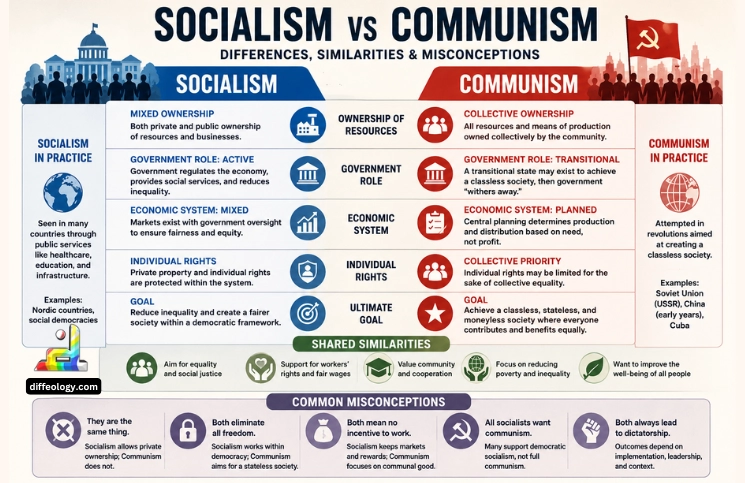
Difference Between Socialism and Communism is about who owns big things and who has power. Socialism is broad. Communism is stricter. Socialism says the economy should help all people.
Communism says key tools of work should be shared. It also wants no class. The word socialist was used around 1830. Marx and Engels wrote The Communist Manifesto in 1848. The Soviet Union lasted from 1922 to 1991. Today, only 5 states still use that name.
Difference Between Socialism and Communism
Both ideas grew in the 19th century. Many workers were poor. Pay was low. Life was hard. Both ideas care about workers. Both want more fairness. But they are not the same. Socialism often backs voting, slow change, and public help. It may also allow small private firms. Communism wants a bigger break from the old system. In much of history, it was tied to one-party rule.
Socialism Vs. Communism
What Is Socialism
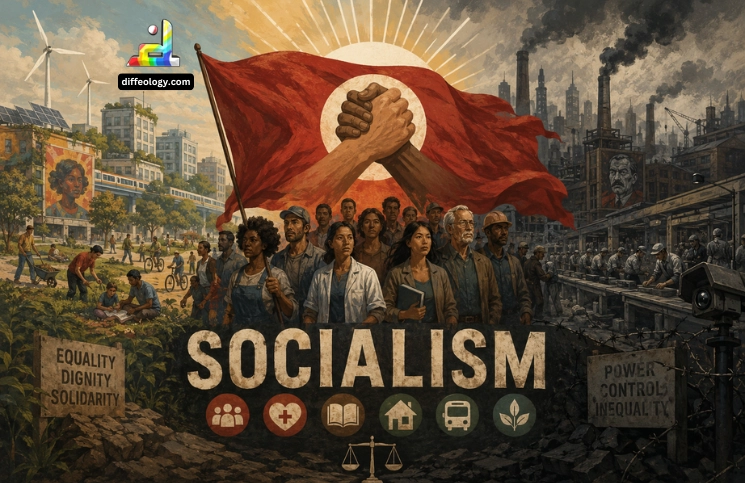
Socialism is an idea. It says big parts of the economy should serve all people. Some systems give the government more control. Others give workers more control. Some still allow voting and private business. These ideas can vary, which is why different systems are not all the same.
Read Also: Difference Between Simile and Metaphor
- Help all people.
- Use public control.
- Use worker control.
- Keep some private business in some form.
What Is Communism
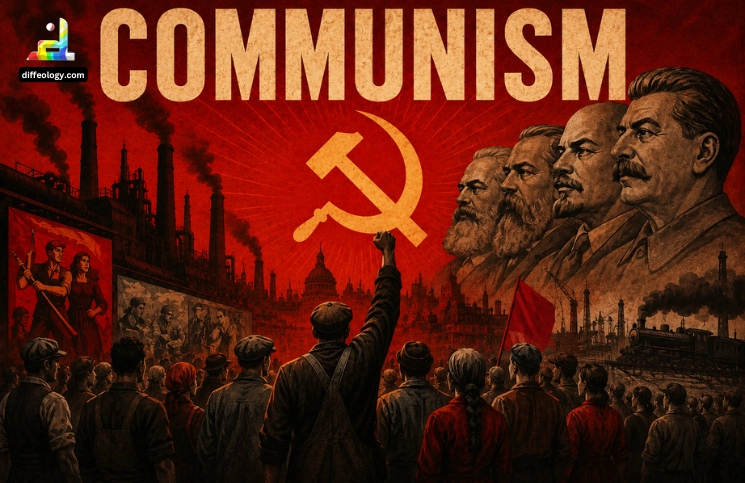
Communism is a system. It aims for no class. It says key work tools should belong to all people.
Read Also: Difference Between Loyalty and Faithfulness
- Share key tools of work.
- End class in full theory.
- End private control of major property.
- Use one-party rule in much of history.
Comparison Table “Socialism Vs. Communism”
| Main idea | Public or worker control | Shared ownership |
| Scope | Broad idea | Narrower branch |
| Private property | May allow some | Aims to end major private control |
| Change | Often by reform | Often by revolution |
| Political system | May work with many parties | Often linked with one-party rule |
| Economy | May mix market and state | Often uses state plans |
| Famous dates | Around 1830 | 1848, 1917, 1922, 1949, 1991 |
| End goal | Fairer sharing | Classless and stateless society |
| Modern note | Welfare states may fit here | Only 5 official communist states remain today |
Difference Between Socialism and Communism in Detail
Get to know the Socialism Vs. Communism in Detail.
1. Ownership of Property
Socialism may put big fields like power, health care, and transport in public hands. Some forms still allow small private firms.
Communism goes further. It wants the key work property shared by all. In real life, many states put it under state control.
2. Role of the State
Socialism has no one fixed model. Some groups want a strong state. Some want more power for workers and local groups.
Communism often led to a stronger state. Ruling parties often kept tight control over public life.
3. Method of Change
Many socialist groups wanted change through votes, unions, labor laws, and public debate. They wanted slow reform.
Communist groups were more often linked with revolution. That is why many people see Communism as a harder path.
4. Democracy and Political Freedom
Many forms of Socialism work with democracy. People can vote. Parties can compete. Private business can still exist.
Many communist states were different. They often allowed little dissent. One-party rule often uses tight control.
5. Markets and Economic Planning
Some socialist forms accept markets, but under state rules. A Mixed Economy joins markets with state action.
Communist states often used central planning. The state often sets output, prices, wages, and goals.
6. Class, Equality, and Income
Socialism tries to cut unfair gaps in income, wealth, and power. It wants life to be fairer.
Communism aims for a bigger end goal. It wants a classless and stateless society in theory.
7. Real-World Results and Examples
Modern welfare states usually fit the Mixed Economy model, not full Communism. They may have welfare, health care, and labor rights.
Communist history has a clearer path. Russia changed after 1917. China came under communist rule in 1949. Today, only 5 official communist states remain.
Key Difference Between Socialism and Communism
Here are the key points showing the Difference Between Socialism Vs. Communism.
- Meaning — Socialism is broad. Communism is strict.
- Ownership — Socialism may cover key parts. Communism wants the key work property shared.
- Private Property — Some socialist forms allow small private firms. Full Communism does not.
- Change — Socialism may use reform. Communism is linked more with revolution.
- Democracy — Socialism may work with elections. Communist rule often did not.
- State Power — Socialist forms differ. Communist rule often used tight state control.
- Markets — Some socialist forms keep markets. Communist rule often used state plans.
- End Goal — Socialism seeks a fairer life. Communism seeks a classless and stateless society.
- Public Image — Socialism is often linked with welfare states. Communism is often linked with one-party rule.
- Famous Text — The Communist Manifesto was published in 1848.
- Famous Dates — Key dates include 1917, 1922, 1949, and 1991.
- Modern Spread — Only 5 official communist states remain today.
- Welfare Spending — Some states use welfare and still have mixed economies.
- Theory and Practice — Theory says no classes and no state, but history often shows strong states.
FAQs: Socialism Vs. Communism
Conclusion
Difference Between Socialism and Communism is easy to see through 3 points: ownership, method, and end goal. Socialism often backs public control or social ownership, but it may still allow votes, reform, unions, and some private business. Communism wants shared ownership and no class, but in modern history, it was often linked with one-party rule and central planning.
A welfare state, a Mixed Economy, a socialist party, and a communist state are not the same thing. Socialism has many forms. Communism is more strict in theory and was often harsher in practice.
References & External Links
- Understanding Socialism: History, Theory, and Modern Examples
- Understanding Communism: Ideology, History, and Global Impact

