

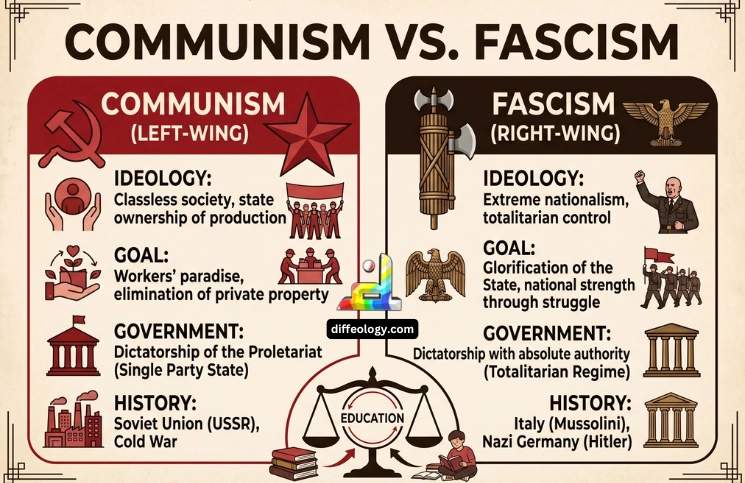
Difference Between Communism and Fascism is about how power, money, fear, and hope affect normal people. Communist policy is that wealth should be more evenly distributed. Fascism’s words are the following: the nation and the leader come first.
The Soviet Union existed between 1922 and 1991. Nazi Germany ruled from 1933 to 1945. These thoughts were not only recorded in books. They shifted residences, careers, privileges and lives.
Main Difference Between Communism and Fascism
The main difference is simple. Communism is about class and wealth. It desires to bring down the inequality between the rich and the poor. Fascism is based on nation, pride, identity and obedience. It would like people to listen to a strong leader and serve the state. Both can be destructive when leaders obtain excessive power, but each has different objectives.
Communism Vs. Fascism
What is Communism?
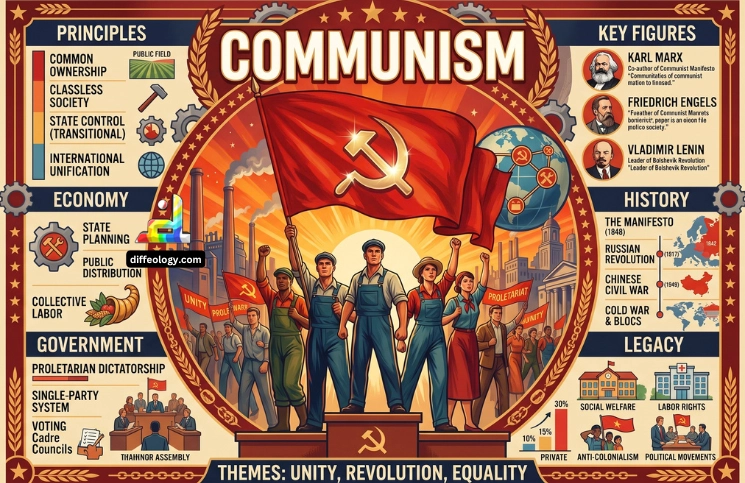
Communism is a political and economic ideology. It is the duty of land, factories, banks and big resources to assist all people, not only rich owners. In 1848, The Communist Manifesto was published and modern communism was well known. This concept is fair and hopeful to the poor worker. However, in many true countries, communism endowed the state with massive powers.
Read Also: Difference Between Socialism and Communism
- Takes efforts to narrow class differences.
- It allows for public or state control of key industries.
- The Soviet Union started in 1922.
- In 1949, China turned into a communist nation.
- In many communist countries, there was a restriction on freedom of expression, freedom of choice in elections, freedom of religion, and freedom of private enterprise.
What is Fascism?
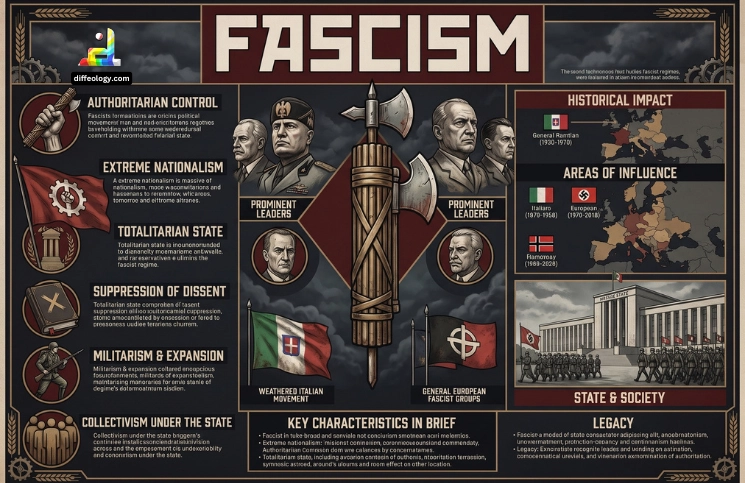
Fascism is a right-wing political concept. It states that the country is more important than an individual. It fosters one strong leader, high loyalty and a high level of control. The fascists increased in strength after World War I when many people were poor, angry and afraid. Leaders tapped into that fear. Italy was ruled by Benito Mussolini from 1922 to 1943. Adolf Hitler’s reign over Germany was from 1933 and 1945.
Read Also: Difference Between Monarchy and Democracy
- It supersedes the welfare of the individual to that of the nation.
- It doesn’t work well in chaos or weak leadership.
- Uses fear, propaganda, police and military force often.
- Under the Nazi’s rule, there was the Holocaust, which claimed the lives of approximately six million Jews.
- The death toll of WWII is estimated to be 35 million to 60 million.
Comparison Table “Communism Vs. Fascism”
| Main idea | Class equality | National strength |
| Political side | Far left | Far right |
| Economy | Public or state ownership | Private business under state control |
| Leadership | Party rule | One strong leader |
| Class view | Wants fewer class gaps | Supports hierarchy |
| Nation | Less central in theory | Very central |
| Property | Limits major private ownership | Allows property with control |
| Freedom | Often limited in practice | Often limited by design |
| Main target | Class enemies | Outsiders, minorities, rivals |
| Example | Soviet Union | Fascist Italy, Nazi Germany |
Difference Between Communism and Fascism in Detail
Get to know the Communism Vs. Fascism in Detail.
- Main Belief
The first principle of communism is class. It has been said that society is unfair when a group of wealthier people owns land, factories, jobs and money. It’s emotional and powerful: labor should share in what it produces.
The fascist movement begins with the nation. It states that people are to support one leader and one state. Does not concentrate on the equality of wealth. Its themes are pride, power, order and loyalty.
- View of People
Communism resonates with workers, the poor and those who feel marginalized. It states that the common people should not live under the control of their rich owners.
The fascist ideology subdivides men into nations, races, identities, or loyalty. The “real” citizens are treated as such. Some others might be blamed or attacked. This can lead to fear becoming cruel.
- Role of the State
In communist theory, the state is like the Industrial Revolution that will eventually go away. However, in the real communist countries, it became quite strict. There were 15 Soviet republics until 1991.
Fascism is openly seeking a strong state. Politics, media, schools, and public life are in the hands of the state. Dissension against the leader can make him look like an enemy.
- Economy and Property
In most cases, communism restricts the private control of key resources. The State can run big factories, banks, mines and land.
Fascism likes to tolerate private business. However, the State needs the backing of business. Owners can make a profit, but they have to be loyal to the government.
- Freedom and Rights
One of the benefits that communism generally claims is to eliminate poverty. It is a promise that can be quite strong for people who are hungry, low-paid, or treated unfairly at work.
The fascist state gives security, pride, and order. However, under the unchecked power of both systems, speech, free press, fair elections, and protest can be eliminated.
- Nation and Identity
There is generally a worldwide theory of communism. It states that workers in all of the countries struggle in the same way. It isn’t nationality, it is class.
The fascist tendency is highly nationalistic. It involves flags, songs, uniforms, slogans and rallies. It instructs people to love the country, to have confidence in the leader and to be afraid of the enemy.
- Historical Results
Russia, China, Cuba, Vietnam, and North Korea were influenced by communism. It ushered in land reform, mass education, industry, censorship and political control.
The countries most influenced by fascism were Italy and Germany, before and during World War II. The outcomes of it were dictatorship, racism, war, suffering, and mass death.
Key Difference Between Communism and Fascism
Here are the key points showing the Difference Between Communism Vs. Fascism.
- Core Goal
Communism has a goal of equality among classes. Fascism has a thirst for military might and total submission.
- Political Side
The communists are typically somewhere on the left. Fascism tends to be very right-wing.
- Class
Communism does not want any larger gaps between classes. Fascism has accepted rank and hierarchy.
- Nation
In communist circles, there is discussion of workers everywhere. Fascism is a doctrine of the elevation of one Nation.
- Leader
In communism, one ruling party is given power. One strong leader is frequently the rule in fascism.
- Economy
Communism is pro-public or state ownership of big industries. Under fascism, business is allowed to operate under the pressure of the state.
- Private Property
In communism, there is a restriction on the extent of private ownership. Under fascism, property is acceptable as long as it serves the state.
- Rights
Both systems are capable of suppressing speech, voting, the press, and protest as a dictatorship.
- Main Enemy
Class enemies are frequently the targets of communism. Fascism tends to focus on the outside, the minority and the opposition.
- Religion
Communist countries tend to subjugate religious authority. Religion can be used by fascist states in the service of national unity.
- Military
In fascism, the army is the key player. Communist nations can also have powerful armies.
- Voting
In both systems, real political choice may be foreclosed. Opposition is weak or prohibited in elections that may take place.
- Propaganda
In communist societies, classes are used for communication. Fascism relies on pride, fear, symbols and leader worship.
- Simple Meaning
Communism is the class issue and the wealth issue. Fascism is a nation, an identity, a power, and a control ideology.
FAQs: Communism Vs. Fascism
Conclusion
Difference Between Communism and Fascism is important because both concepts had an impact, not just on governments but on real people. Communism talks of sharing and equality of classes. Fascism is a discourse of nation, rules, and allegiance to a leader. History is very clear: when there are no limits to power, common people are often the victims.
References & External Links
- The Principles of Communism
- The Fourteen Tenets of Fascism: A Framework for Understanding Modern Politics

