

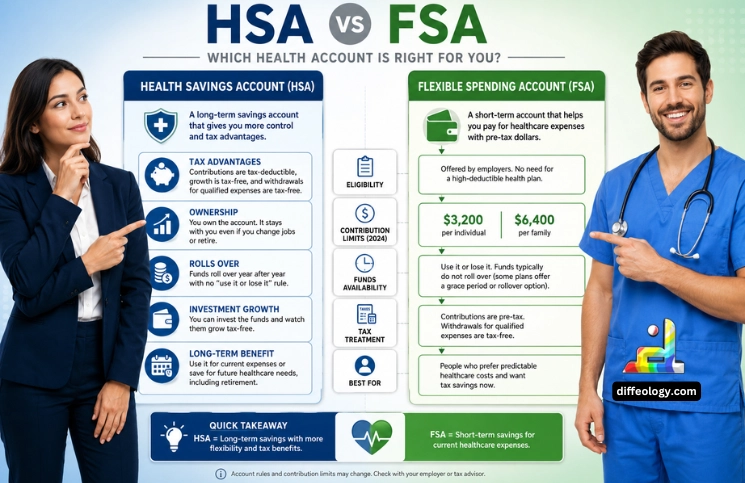
Difference Between HSA and FSA matters because both accounts help pay for health care with tax-free money, but they work in very different ways. HSA means Health Savings Account. FSA means Flexible Spending Account. Both can pay for many health costs, such as doctor visits, medicine, dental care, eye exams, glasses, and some other approved medical items. The big point is how the money is saved, who owns it, and what happens if it is not used.
In 2026, the IRS allows an HSA limit of $4,400 for self-only coverage and $8,750 for family coverage. A health FSA limit is $3,400 for employee salary reduction money. Some FSA plans may let unused money carry over, but the 2026 carryover limit is $680 if the employer allows it. An HSA can be a better fit for long-term savings because unused money can stay in the account year after year. An FSA can be better for planned yearly costs because the full yearly amount may be ready early in the plan year.
The right choice depends on the health plan, job benefits, expected bills, and how much risk a person can handle. The 2026 figures above come from IRS updates on HSA, HDHP, and health FSA limits.
Main Difference Between HSA and FSA
The main difference between HSA and FSA is ownership. An HSA belongs to the person. The money can stay there even after a job change. It can also roll over each year. An FSA is usually linked to an employer. It is often used for costs that will happen during the same plan year. An HSA also needs an HDHP, which means High Deductible Health Plan. An FSA usually does not need that type of plan, but it must be offered by an employer.
HSA Vs. FSA
What Is HSA?

An HSA, or Health Savings Account, is a tax-friendly account for health costs. It works only when a person has an HSA-eligible HDHP. In 2026, that plan must have a deductible of at least $1,700 for self-only coverage or $3,400 for family coverage. The out-of-pocket limit must not be more than $8,500 for self-only coverage or $17,000 for family coverage. These rules are important because not every health plan lets a person add money to an HSA.
An HSA can help with both current bills and future bills. Money in the account can roll over each year. Some HSA providers also offer investment options. This means the account may grow over time if the funds are not spent right away. People age 55 or older may also be able to add an extra $1,000 as a catch-up contribution.
Read Also: Difference Between HMO and PPO
- HSA money can pay for approved health costs.
- HSA money can roll over every year.
- HSA money stays with the person.
- HSA funds may grow if the account allows investing.
- HSA needs an HSA-eligible HDHP.
What Is FSA?

An FSA, or Flexible Spending Account, is an employer benefit. It lets an employee put money from pay into an account before taxes. That money can then pay for approved health costs. These costs may include copays, medicine, dental visits, eye care, braces, and glasses. A health FSA is useful when health costs are easy to guess before the year starts.
A health FSA has a use-it-or-lose-it risk. Some plans give a grace period. Some plans allow carryover. For 2026, the health FSA limit is $3,400. If the employer allows carryover, up to $680 may move to the next year. An FSA is best for costs that are likely to happen soon.
Read Also: Difference Between Medicare and Medical
- FSA money comes from pre-tax pay.
- FSA is usually offered by an employer.
- FSA works well for planned yearly costs.
- FSA funds may expire.
- FSA carryover depends on employer rules.
Comparison Table “HSA Vs. FSA”
| Full name | Health Savings Account | Flexible Spending Account |
| Main use | Save and pay for health costs | Pay planned yearly health costs |
| Health plan needed | HSA-eligible HDHP | Usually no HDHP needed |
| Owner | Person | Employer plan |
| 2026 limit | $4,400 self-only, $8,750 family | $3,400 |
| Rollover | Yes | Limited |
| 2026 carryover | No set yearly cap like FSA | Up to $680 if allowed |
| Job change | Stays with person | May not stay |
| Best for | Long-term savings | Planned yearly bills |
Difference Between HSA and FSA in Detail
Get to know the HSA Vs. FSA in Detail.
1. Eligibility Rules
An HSA has strict rules. A person must have an HSA-eligible HDHP. For 2026, the minimum deductible is $1,700 for self-only coverage and $3,400 for family coverage. This makes an HSA tied to a certain type of health plan.
An FSA is usually easier to get if the employer offers it. A regular health FSA does not require an HDHP. The main rule is that the workplace benefit plan must include it.
2. Account Ownership
An HSA belongs to the person. If the person changes jobs, the HSA money can still stay in the account. It can also be used later for approved health costs.
An FSA is linked to the employer plan. If the person leaves the job, unused FSA money may not always stay available. The plan rules decide what happens next.
3. Contribution Limits
An HSA has higher limits than a health FSA. In 2026, the HSA limit is $4,400 for self-only coverage and $8,750 for family coverage. People age 55 or older may add $1,000 more.
A healthy FSA has a lower limit. In 2026, the employee limit is $3,400. This makes an FSA useful for yearly costs, but less useful for long-term savings.
4. Rollover Rules
An HSA has a strong rollover value. Unused money does not expire at the end of the year. It can stay in the account for future health needs.
An FSA has stricter rules. Some plans allow a carryover, and some give extra time to spend the money. For 2026, the allowed carryover can be up to $680 if the plan offers it.
5. Tax Benefits
Both HSA and FSA accounts can lower taxable income. That means the money can be used for health costs before normal income tax is taken out.
An HSA may have a stronger tax edge over time. The money can go in tax-free, grow tax-free, and come out tax-free when used for approved health costs. An FSA is more of a yearly spending account.
6. Best Use Case
An HSA is best for people who want to save for future health costs. It can help with large bills later, such as surgery, dental work, or care in older age.
An FSA is best for people who know their yearly health costs. It can help with glasses, dental visits, regular medicine, braces, therapy, or planned care.
7. Access to Money
An FSA may give access to the full chosen yearly amount near the start of the plan year. This can help if a large bill comes early.
An HSA usually works with the money already in the account. If only $500 has been added, then only $500 is usually ready to use.
Key Difference Between HSA and FSA
Here are the key points showing the Difference Between HSA Vs. FSA.
1. Health Plan Rule
An HSA needs an HSA-eligible HDHP. A healthy FSA usually does not need an HDHP.
2. Owner
An HSA belongs to the person. An FSA is linked to the employer plan.
3. Limit
In 2026, an HSA limit is $4,400 self-only and $8,750 family. A health FSA limit is $3,400.
4. Rollover
HSA money rolls over each year. FSA money may expire.
5. Carryover
A health FSA may carry over up to $680 in 2026 if allowed. An HSA does not have that same carryover cap.
6. Job Change
An HSA can move with the person. An FSA may not.
7. Long-Term Use
An HSA can help build health savings. An FSA is best for costs within the plan year.
8. Investment Option
Some HSA accounts allow investing. A health FSA is not built for investing.
9. Risk
An HSA has less risk of losing unused money. An FSA has more risk if money is not spent on time.
10. Age Rule
An HSA may allow an extra $1,000 at age 55 or older. A health FSA does not have this same rule.
11. Employer Need
An FSA usually needs an employer plan. An HSA can be opened if the person has the right health plan.
12. Best Fit
An HSA fits savers. An FSA fits planners with known yearly bills.
FAQs: HSA Vs. FSA
Conclusion
Difference Between HSA and FSA is simple when the main points are compared side by side. An HSA is owned by the person, needs an HSA-eligible HDHP, has higher 2026 limits, and can roll over year after year. An FSA is linked to an employer, has a 2026 limit of $3,400, and works best for health costs that are easy to plan. An HSA is often better for saving money for later. An FSA is often better for paying known bills during the year. The best choice depends on the health plan, expected medical costs, job benefits, and how much money may be spent before the plan year ends.
References & External Links
- Understanding Health Savings Accounts (HSAs): Benefits, Rules & Limits
- Using a Flexible Spending Account (FSA)

