

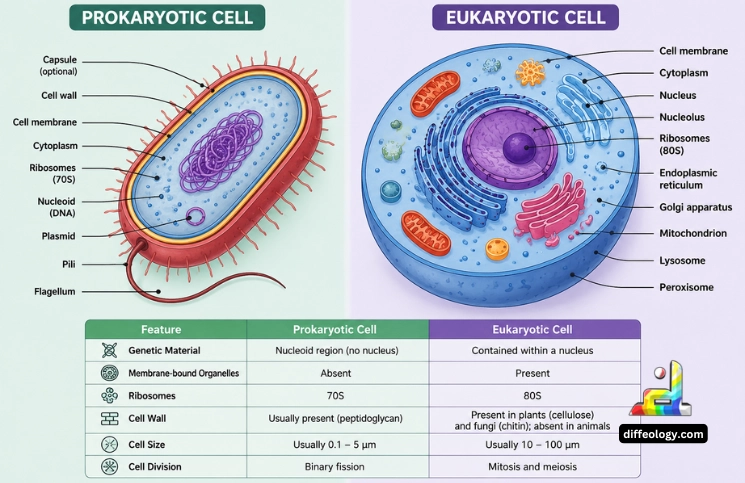
Difference Between Prokaryotic and Eukaryotic Cell is an important biology topic. Cells are present in all that is alive. They are the smallest units possible and are the basic unit of all living things. Cells can be examined using many techniques including Light Microscopy, Electron Microscopy, Fluorescence Microscopy, Gram Staining, Cell Culture or DNA Sequencing.
Main Difference Between Prokaryotic and Eukaryotic Cell
A prokaryotic cell does not contain a true nucleus and a eukaryotic cell does. A prokaryotic cell is generally smaller and less complex and mostly single celled whereas a eukaryotic cell is larger and more complex.
Prokaryotic Vs. Eukaryotic Cell
What is Prokaryotic Cell?
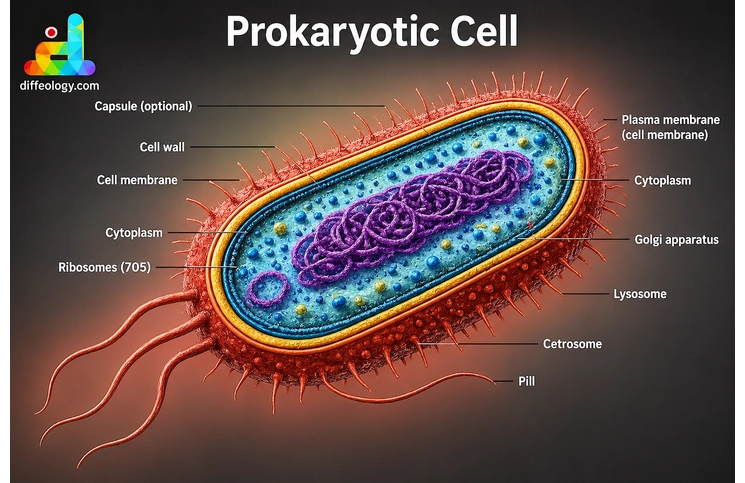
A prokaryotic cell is a very primitive cell which does not have a true nucleus. The meaning of the word prokaryote is” before nucleus”. Prokaryotic cells are present in bacteria and archaea that are primitive cells. Prokaryotic cells are very small in size for example the size of a typical cell can be 0.1-5.0 um.
In these cells the DNA is not situated in a nucleus. It is still in the cytoplasm, but in a part known as a nucleoid. Most of the DNA in a prokaryotic cell is one large ring. There are many small rings of DNA, known as plasmids. These help bacteria survive in harsh places.
Read Also: Difference Between Plant and Animal cells
Main features of Prokaryotic Cells:
- No real nucleus: DNA remains in cytoplasm.
- Small: generally in the 0.1- 5.0 m range.
- Almost unicellular: a single cell can handle all the jobs of life.
- Microbial circular DNA. If they’re circular most have just 1 primary DNA circle.
- Plasmids: Might occur, this would be several little rings of DNA.
- Any membrane-bound organelles No mitochondria, Golgi Body, or chloroplasts.
- 70S ribosomes: Though they have a role in making proteins.
- Cell wall: Good protection and shape which is found in most.
- The study technologies that allow scientists to study them are Gram Staining, Light Microscopy and DNA Sequencing.
What is Eukaryotic Cell?
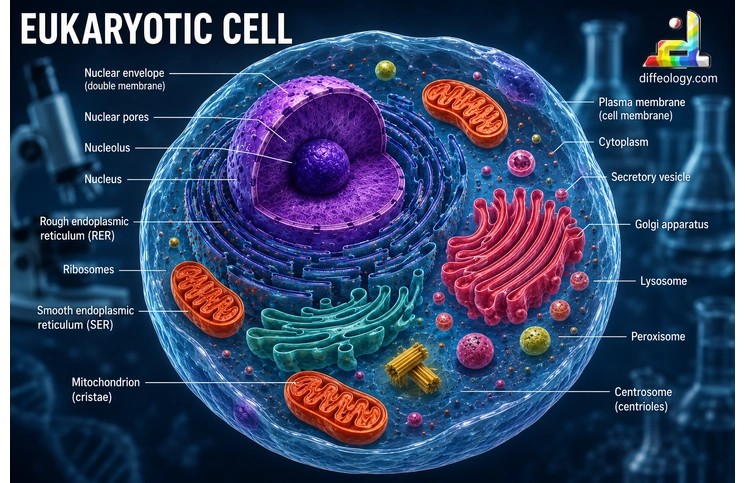
Eukaryotic- This is the name for a larger cell that has a real nucleus. The word eukaryotic means “true nucleus”. This term is used for a cell where the DNA is stored in the nucleus. The nucleus of the cell can be used as a sort of control center as it contains all the genetic material. Eukaryotic cells can be found in animals, plants, fungi and some types of protists. Examples include human cells, all leaf cells, cells in yeast and amoeba. Eukaryotic cells are of a diameter about 10-100 m, although they are much bigger than prokaryotic cells. Eukaryotic cells contain a lot of different parts known as organiselles.
Read Also: Difference Between Mitosis and Meiosis
Main features of Eukaryotic Cells:
- A real nucleus: DNA is in the nucleus.
- Big size Usually on the order of 10-100 m.
- Membrane bound organelles. Which consist of the following, Golgi body and Mitochondrion.
- Linear DNA: The DNA is confined to chromosomes.
- Cell division: Two types, mitosis and meiosis, are used.
- Cell wall–cellulose for the most part.
- Animal cells: No cell wall.
- Scientists can study nature by using various study technologies. Study technologies include Electron Microscopy, Fluorescence Microscopy, Cell Culture and DNA Sequencing.
Comparison Table “Prokaryotic Cell Vs. Eukaryotic Cell”
| Nucleus | No true nucleus | True nucleus present |
| Size | About 0.1–5.0 µm | About 10–100 µm |
| DNA place | Cytoplasm | Nucleus |
| DNA shape | Circular | Linear |
| Organelles | No membrane-bound organelles | Many membrane-bound organelles |
| Ribosomes | 70S | 80S |
| Cell division | Binary fission | Mitosis or meiosis |
| Cell wall | Usually present | Present in plants and fungi |
| Animal cell wall | Not related | Absent |
| Examples | Bacteria and archaea | Animals, plants, fungi, protists |
| Common technology | Gram Staining | Electron Microscopy |
| DNA study technology | DNA Sequencing | DNA Sequencing |
Difference Between Prokaryotic and Eukaryotic Cell in Detail
Get to know the Prokaryotic Vs. Eukaryotic Cell in Detail.
-
Nucleus
The prokaryotic cell (pro means before). By definition it doesn’t contain a real nucleus. The DNA just floats around in the cytoplasm. The DNA is found in an area called a ‘nucleoid’. The nucleoid isn’t surrounded by a membrane.
A eukaryotic cell has a true nucleus. It is an organelle enclosed within a membrane. It protects all the DNA and holds everything together in one place, in a certain area of the cell. In humans, all the cells in the body contain 46 chromosomes.
-
Cell Size
Small cells.Every single of the Prokaryotic cells is approximately 0.1-5.0 m. The minimum size makes the transport of food into a cell and out of the cell much easier.
Eukaryotic cells are larger. Most are about 10-100 m. The best thing to remember about the size of a eukaryotic cell is they are larger for the organelles to carry and deal with things in the cell.
-
DNA Shape
In a prokaryote the DNA is circular in shape. There will usually be one large circle of DNA in the cell, and some prokaryotes will also have some smaller circles called Plasmids.
Eukaryotic DNA is unique because it is linear, and it exists in a cell as several chromosomes. This is a phenomenal method of packing many gigabytes of information, into a remarkably ordered system.
-
Cell Organelles
The cell is devoid of membrane bound organelles. It does not contain mitochondria, chloroplast, Gogli body, endoplasmic reticulum etc. The cell machinery is carried out in cytoplasm or in the general vicinity of the cell membrane.
There are a lot of organelles in a eukaryotic cell. The mitochondria carries the energy of the eukaryotic cell. The chloroplast in PLANT cells allows them to prepare their own food. The golgi is the cell’s packaging and delivery point.
-
Ribosomes
There are various types of ribosomes. Each ribosome has been increased to produce proteins. The 70S ribosomes have been seen in the prokaryotic cell and they are smaller than the eukaryotic cells.
EightyS ribosomes are in the cytoplasm of the eukaryotic cell and it is how they work that results in the production of proteins, required for the growth and repair of the cell. It is this difference that allows antibiotics to be used in bacterial infection.
-
Cell Wall
Mostly, the cells of prokaryots have a cell wall. Frequently in bacteria, the cell wall contains peptidoglycan. It helps the cell to obtain the cell shape and provides some protection.
Cells eukaryotes Cell walls are found in some eukaryotic cells. The cells of plants have cell walls that contain cellulose. The cells of fungi have cell walls that contain chitin. Animal cells do not contain cell walls.
-
Cell Division
In Prokaryotic cell binary fission occurs. In this cell division 1 cell copies its DNA and splits itself into 2 cells. This is a very basic cell division.
Eukaryotes are more complex organisms. They are also able to make new cells by mitosis and meiosis. Mitosis is used in growth and repair, whereas meiosis makes sex cells. Both require more stages than binary fission.
Key Difference Between Prokaryotic and Eukaryotic Cell
Here are the key points showing the Difference Between Prokaryotic Vs. Eukaryotic Cell.
- Nucleus
The cells of prokaryotes cells don’t have a true nucleus, in contrast to those of the eukaryotes. - Size
Prokaryotic cells are approximately 0.1-5.0 m. Eukaryotic cells are approximately 10-100 m. - DNA Place
Prokaryotic DNA is found in the Cytoplasm. Eukaryotic DNA is found within the Nucleus. - DNA Shape
Prokaryotic DNA is normally circular. Eukaryotic DNA is normally linear. - Organelles
The prokaryotic cell does not contain any membrane bound organelles. The eukaryotic cell contains many organelles. - Ribosomes
Prokaryoic cells possess 70S ribosomes. Eukaryotic cells contain 80S ribosomes. - Cell Wall
Most prokaryotic cells have a cell wall. The cells of plants and fungi (eukaryotic cells) also possess cell walls while animal cells do not. - Cell Division
Prokaryotic cells reproduce through binary fission. Eukaryotic cells reproduce through mitosis or meiosis. - Examples
Bacteria and archaea are prokaryotic whereas animals, plants, fungi and protists are eukaryotic. - Mitochondria
Mitochondria-Cells without mitochondria are prokaryotic. Cells with mitochondria are most commonly eukaryotic. - Chloroplasts
No chloroplast is found in Prokaryotic cells. The chloroplast can be seen in the plant cells and some algae. - Complexity
Prokaryotic! Cells are like this. Eukaryotic! Cells are like this. - Cell Type
Most are single-celled. Cells are single-celled. Eukaryotic
FAQs: Prokaryotic Vs. Eukaryotic Cell
Conclusion
Difference Between Prokaryotic and Eukaryotic Cell is easy to understand. Every kind of bacteria, and the archaea are prokaryotic. Eukaryotic cells are larger and more complex in design. They have a true nucleus, many cell organelles that contain cell membranes and they contain linear DNA which is packaged in chromosomes. Every kind of animal, plant, fungi and protists is eukaryotic. Both cell types are important for life. Both contain DNA, cytoplasm, ribosomes and a cell membrane. Prokaryotic cells are designed for simple and quick life processes. Eukaryotic cells are designed for larger bodies and more special tasks.
References & External Links
- Prokaryote Definition, Example, & Facts
- Eukaryotic cell Structure and organelles

