

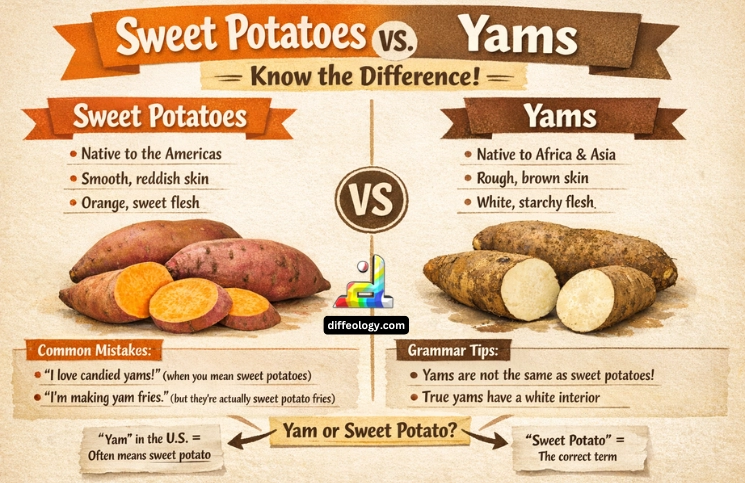
Difference Between Sweet Potatoes and Yams is a topic many people struggle to understand. One reason confusion happens? These two get sold side by side, appearing nearly identical on shelves. Large grocery chains tend to label orange-fleshed tubers as yams, even though real yams come from entirely different species. No relation whatsoever – where one creeps just below soil level, the other dives down sharply, aggressively. Nutrition profiles differ too, not mirror images. Imagine moist texture, naturally sweet flavor, loaded with nutrients like vitamin A – now you’re picturing the sweet potato.
A true yam has a texture you notice – dense inside, less moist when chewed, often stretching past elbow to fingertip. On today’s fields, sweet potatoes rise from tech-assisted ground: sensors track dampness deep below, irrigation lines feed drops at steady intervals, machines place every slip with spacing precision. Bare hands breaking warm earth – that marks the start of most tropical yam plots. Distinctions between them shape what lands on plates, fuels bodies, fits routines.
Main Difference Between Sweet Potatoes and Yams
People often confuse the two, but sweet potatoes belong to another botanical family compared to yams. When heated, sweet potatoes develop a naturally sugary taste and soften through their core. On the flip side, yams rarely gain much flavor, keeping a firm, almost gritty consistency even after cooking. Nutritionally, they go separate ways – one portion of orange-centered sweet potato supplies well beyond quadruple the daily requirement for vitamin A. Yet because of their rich starch load, yams offer more sustained energy for movement and exertion.
Sweet potatoes pop up in nearly every grocery store, while real yams stay rare. Because of weather monitors and crop sensors, growing sweet potatoes now leans on tech – yam farming still mostly waits for rainfall. Despite new methods spreading, many regions stick to old patterns when planting tubers. Machines help predict harvests for one root, yet the other grows without such aids.
Sweet Potatoes Vs. Yams
What are Sweet Potatoes
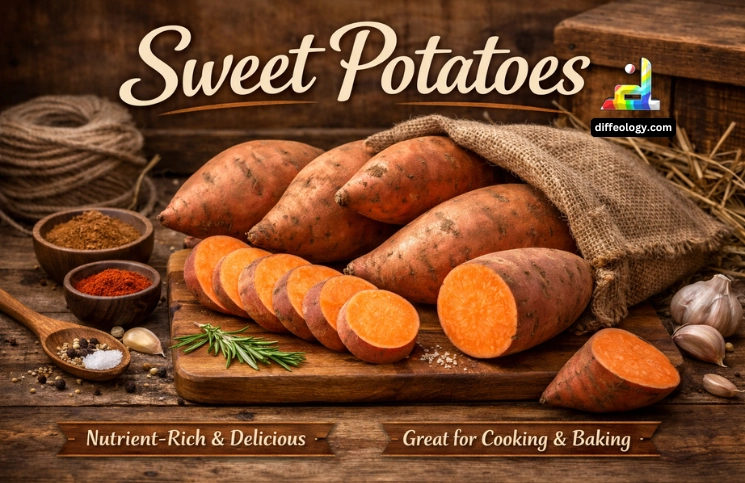
Underground, sweet potatoes develop as roots. Related to morning glories, they turn tender and sugary once heated. For ages people have farmed them – originally in Central and South America. Orange ones appear most often, though white and purple types exist too. Looking much like yams, they’re sometimes mistaken for those tubers. Cooking methods vary widely since these veggies adapt well to heat. Their nutrition profile stands out among common produce.
Read Also: Difference Between Blood Orange and Grapefruit
- Vitamin A: One medium sweet potato gives about 438% of the daily value.
- Vitamin C: About 37% of the daily value per 100 grams.
- Fiber: Around 3 grams per 100 grams, which helps your digestion.
- Calories: About 86 calories per 100 grams, making them a low-calorie food.
- Carbohydrates: Around 20 grams per 100 grams, giving energy for the day
What are Yams
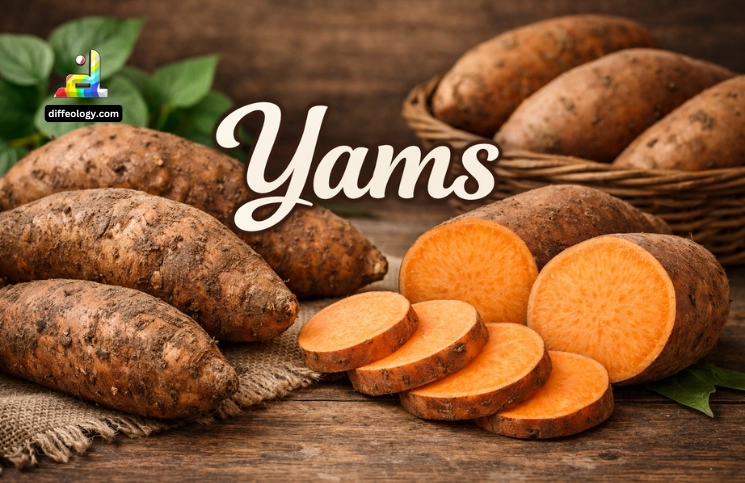
Root vegetables though they may be, yams aren’t the same as sweet potatoes. Across much of Africa, sections of Asia, and scattered Caribbean isles, these root vegetables often grow long – on occasion stretching one hundred fifty centimeters. Their outer layer resembles tree bark: rough, firm, dark. Beneath it lies flesh varying in shade, from light ivory to rich violet or faint crimson tints. Dense with starch, naturally low in moisture, they differ sharply from the damp sugary quality common in true sweet potatoes. Despite sharing soil as underground crops, physical feel draws a clear line between them.
Roots like yams appear regularly at mealtimes – cooked slowly in rich sauces or cut flat for frying. Energy-rich by nature, they tend to dominate dishes rather than linger at the edges. One cook might steam them straight; another lets them steep in rising warmth until taste grows full. Their purpose remains clear: steady nourishment, served quietly, day after similar day.
Read Also: Difference Between Vegetable Oil and Olive Oil
- Calories: About 118 calories per 100 grams, which is higher than sweet potatoes.
- Carbohydrates: Around 27 grams per 100 grams, making them a good source of energy.
- Fiber: About 4 grams per 100 grams, which helps digestion.
- Potassium: Around 816 mg per 100 grams, supporting heart and muscle health.
Comparison Table “Sweet Potatoes Vs. Yams”
| Taste | Sweet | Plain |
| Skin | Smooth | Rough |
| Size | Small | Very large |
| Vitamin A | 400% | Very low |
| Calories | 90 | 120 |
| Availability | High | Low |
Difference Between Sweet Potatoes and Yams in Detail
Get to know the Difference Between Sweet Potatoes Vs. Yams in Detail.
1. Plant Family
Sweet potatoes belong to the morning glory family. These plants grow as vines and develop edible roots. Sweet potatoes are grown in more than 100 countries. Farmers improve crops using seed improvement technology and soil testing tools.
Yams belong to a different plant family related to lilies. They grow as large tubers. Some yams weigh up to 50 kg. Yams are mostly grown by hand with simple tools.
2. Size and Shape
Sweet potatoes are small to medium in size. Most weigh less than 500 grams. They are oval and smooth.
Yams are very large and long. Some reach 1.5 meters in length. Their size makes harvesting harder.
3. Skin and Flesh
Sweet potatoes have thin, smooth skin. The inside can be orange, yellow, or white.
Yams have rough and thick skin. The flesh is white or purple and very firm.
4. Taste and Texture
Sweet potatoes taste sweet because they contain 6–8% natural sugar. They turn soft after cooking.
Yams contain less than 2% sugar. They stay firm and dry after cooking.
5. Nutrition Value
One sweet potato gives more than 400% vitamin A and about 15% fiber. Nutrition labs use food analysis technology to measure this.
Yams give about 120 calories and 28 grams of carbohydrates per serving. They give energy but fewer vitamins.
6. Growing Areas
Sweet potatoes grow in warm areas like China and the USA. China grows about 60% of the world supply using satellite farming tools.
Yams grow mostly in West Africa. This region grows about 90% of all yams.
7. Store Labeling
About 9 out of 10 sweet potatoes are sold as yams in stores. This causes confusion.
Real yams are sold mostly in special stores using import tracking systems.
Key Difference Between Sweet Potatoes and Yams
Here are the key points showing the Difference Between Sweet Potatoes Vs. Yams.
- Origin
Sweet potatoes started in South America. Yams started in Africa. - Plant Type
Sweet potatoes are root vegetables. Yams are tubers. - Skin
Sweet potatoes have smooth skin. Yams have rough skin. - Size
Sweet potatoes are smaller. Yams are much larger. - Taste
Sweet potatoes are sweet. Yams are not sweet. - Flesh Color
Sweet potatoes are orange or yellow. Yams are white or purple. - Sugar
Sweet potatoes have more sugar. - Calories
Yams give about 120 calories per serving. - Vitamin A
Sweet potatoes give 400% daily vitamin A. - Cooking
Sweet potatoes are baked or roasted. Yams are boiled. - Availability
Sweet potatoes are common. Yams are rare. - Growth Time
Yams need more time to grow. - Store Names
Sweet potatoes are sold as yams. - Price
Yams cost more due to low supply.
FAQs: Sweet Potatoes Vs. Yams
Conclusion
You must know the Difference Between Sweet Potatoes and Yams. It guides folks toward better picks for eating well and making meals. Starting soft, orange inside, sweet potatoes bring a sugary taste along with key nutrients. Not quite the same, yams show up bulky, dense with starch, built for fueling bodies. One pops up more in certain tropical zones, another claims different soil spots across continents. Though they get mixed up often, each comes from its own plant family entirely. Depending on the kitchen, one lands in pies, the other might boil into savory dishes instead.

