

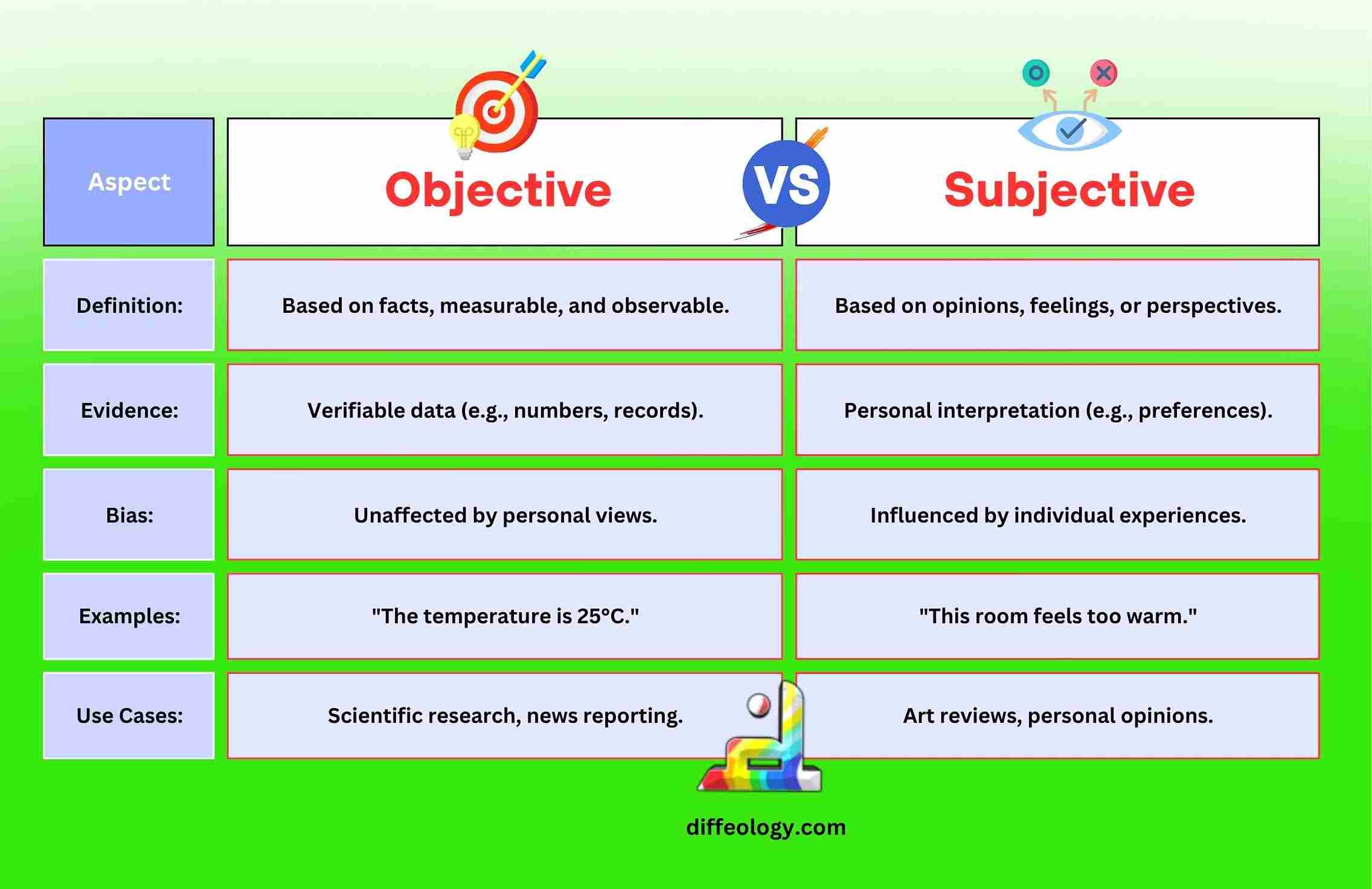
Objective and subjective are two sides of how we view things. Understand the difference between objective and subjective. Objective views rely on facts you can test. Subjective views depend on feelings and opinions that vary by person. According to Dictionary.com, objective is “not influenced by personal feelings or bias” and subjective is “based on personal perspective or preferences”. In 2015, the Corruption Perceptions Index ranked 168 countries by perceived public-sector corruption to show how objective data drives decisions.
This article uses easy words and small sentences. It helps you spot the main ideas and facts behind each term.
Main Difference Between Objective and Subjective
The main difference is that objective sticks to verifiable facts and data. Subjective depends on personal thoughts and feelings. Objective statements stay the same no matter who reports them. Subjective statements change with each person’s views. One is measurable and provable. The other is opinion-based and varies by individual.
Objective Vs. Subjective
What Is Objective
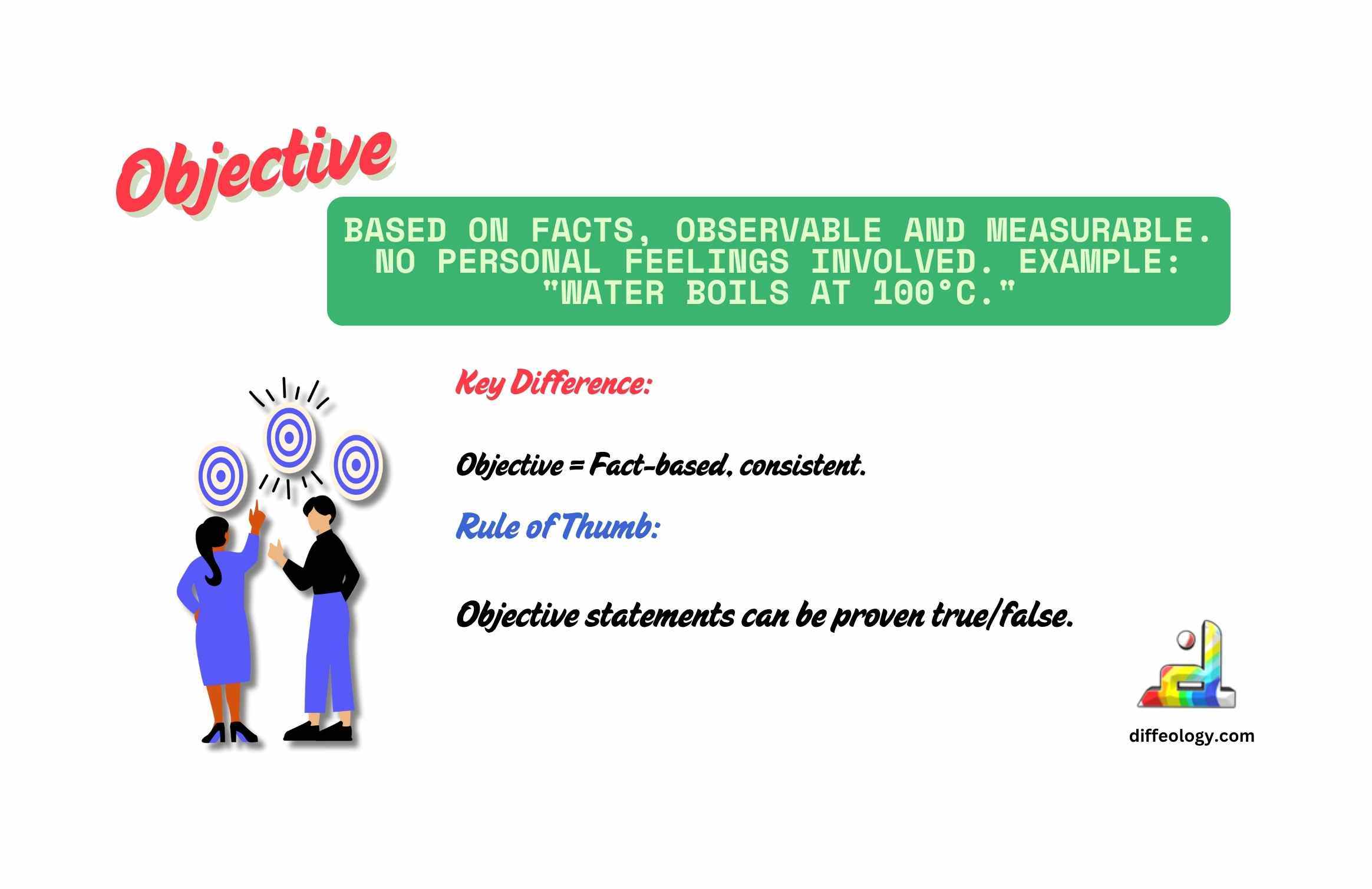
Objective means based on facts. It uses numbers, dates, and evidence. It does not include personal bias. Scientists write papers in an objective tone. Journalists aim to stay objective when they report news. In grammar, objective refers to words that act as objects in a sentence, like “homework” in “She did her homework”.
Read Also: Difference Between Can and Cannot
Objective statements can be checked by anyone. They are quantifiable. For example, water boils at 100 °C at sea level. That statement is true for all people. It does not depend on how anyone feels. It can be counted, measured, and repeated.
What Is Subjective
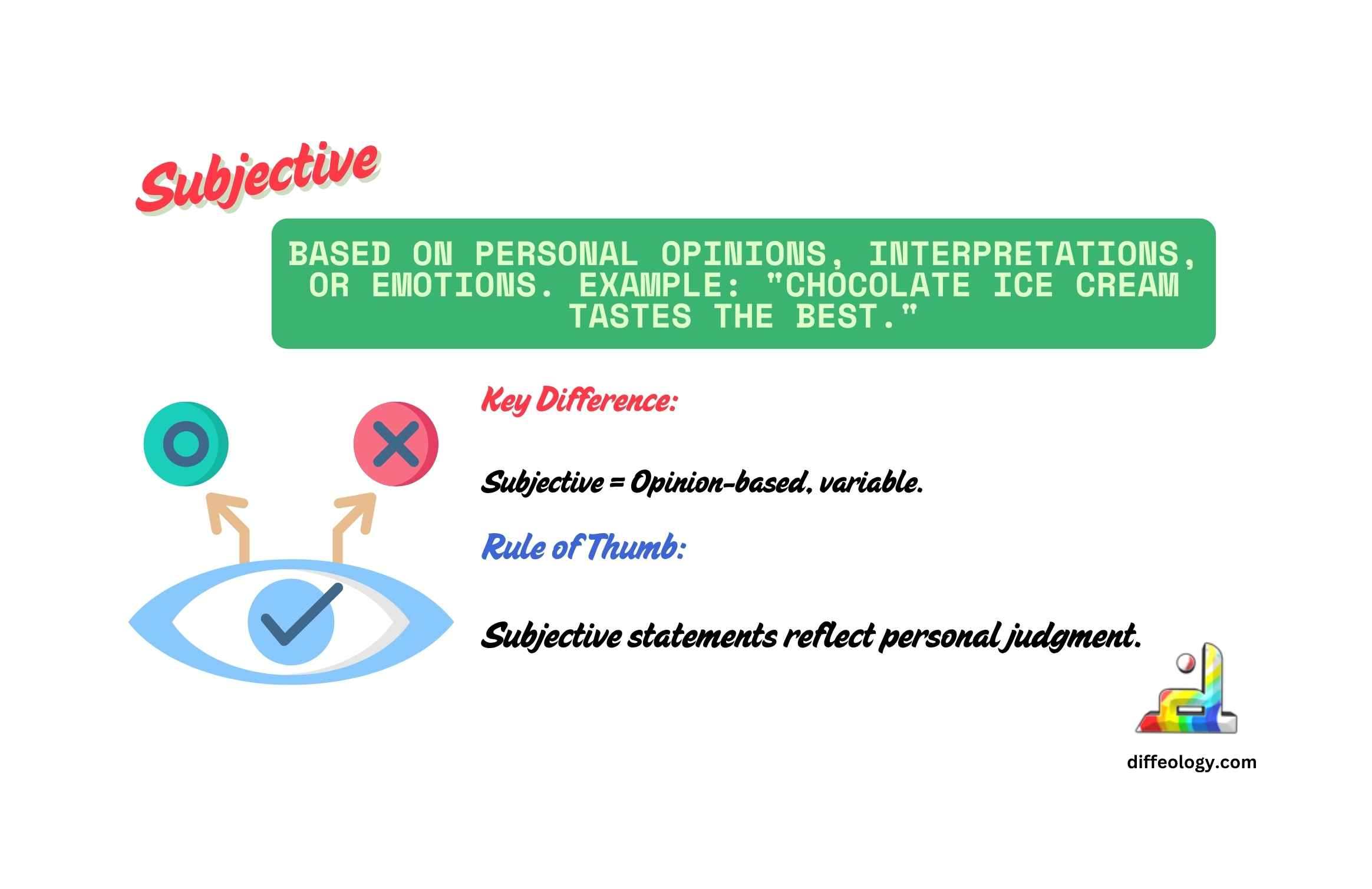
Subjective means based on personal feelings or opinions. It reflects one person’s likes, dislikes, and views. Art reviews are often subjective. People describe taste, color, or style from their own standpoints. In grammar, subjective refers to words that act as subjects, like “I” in “I like ice cream”.
Read Also: Difference Between Complete and Finish
Subjective statements cannot be proved the same way as objective ones. They depend on individual experiences. Saying “This song is sad” is subjective. It shows how one person feels. Another person may feel happy listening to the same song.
Comparison Table “Objective Vs. Subjective”
| Basis | Facts and observations | Emotions and opinions |
| Verification | Measurable and provable | Not easily provable |
| Consistency | Same for everyone | Varies by person |
| Language Style | Third-person, neutral | First-person, personal |
| Typical Use | Science, news, technical writing | Blogs, reviews, personal essays |
| Decision Making | Data-driven | Opinion-driven |
| Bias | Minimized | Embraced |
Detailed Difference Between Objective and Subjective
Get to know the Difference Between Objective Vs. Subjective in Detail.
1. Basis of Information
Objective information rests on observable facts and data. It is neutral. Subjective information relies on personal beliefs and emotions. It is personal.
2. Bias and Neutrality
Objective work aims to remove bias. It tries to be balanced. Subjective work embraces bias. It shows the writer’s stance.
3. Verifiability
Objective statements can be tested and proved. Data and numbers back them. Subjective statements cannot be tested the same way. They depend on personal views.
4. Consistency
Objective facts remain the same across time. They don’t change with opinion. Subjective views change over time. They shift with mood or new experiences.
5. Scope of Use
Objective style suits science, news, and technical writing. Subjective style fits blogs, reviews, and personal essays.
6. Decision Making
Objective data guides fair decisions. It is used in policy and research. Subjective input guides personal or creative choices. It shapes art and taste.
7. Language and Tone
Objective tone uses third-person, neutral words. It stays formal. Subjective tone uses “I” and “we.” It feels informal and personal.
Key Difference Between Objective and Subjective
Here are the key points showing the Difference Between Objective Vs. Subjective.
- Fact vs. Feelings: Objective is about facts you can prove. Subjective is about how you feel.
- Universal vs. Personal: Objective statements apply to everyone. Subjective statements apply to one person.
- Testable vs. Opinion: Objective claims can be tested. Subjective claims are opinions.
- Stable vs. Changeable: Objective facts stay the same. Subjective views change over time.
- Measured vs. Described: Objective uses numbers and measurements. Subjective uses words to describe.
- Balanced vs. Biased: Objective aims for balance. Subjective shows bias.
- Formal vs. Informal: Objective writing is formal. Subjective writing is informal.
- Third-person vs. First-person: Objective uses he, she, it. Subjective uses I, we, my.
- Evidence vs. Emotion: Objective relies on evidence. Subjective relies on emotion.
- Predictable vs. Unique: Objective is predictable. Subjective is unique to each person.
- Scientific vs. Artistic: Objective fits science. Subjective fits art.
- Verifiable vs. Believable: Objective is verifiable by anyone. Subjective is believable to some.
- Data-driven vs. Story-driven: Objective is data-driven. Subjective is story-driven.
- Impartial vs. Personal: Objective is impartial. Subjective is personal.
FAQs: Objective Vs. Subjective
Conclusion
Understanding the difference between objective and subjective helps us mix facts with feelings in the right way. It guides how we write, decide, and share ideas.
References & External Links
- Objective in a sentence
- Examples of Subjective in a sentence

