

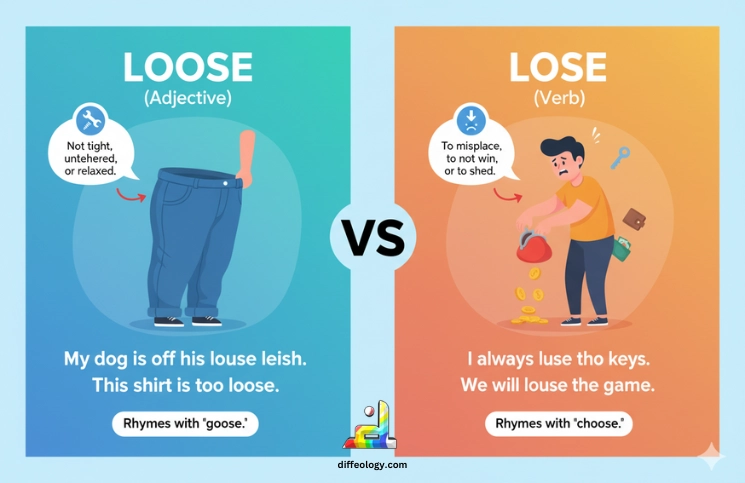
Both loose and lose look similar, yet they work in different ways in real life writing and speaking, and this mix-up happens a lot because the words differ by just 1 letter and end with a similar sound. Here, you will find the difference between loose and lose.
Loose has 5 letters and is an adjective (describing things), while lose has 4 letters and is a verb (an action), and both are 1-syllable words you say fast: “loos” vs “looz”. When you weigh usage, you will find that “lose weight” shows up in far more everyday phrases than “loose weight”, and grammar tools often flag this mistake quickly. A simple memory trick helps: if you can put “very” before it (“very loose”), you want the adjective with 2 o’s, but if it shows an action (“to lose”), it is the verb with 1 o.
Writers often check endings too: nouns take “loosening” for the adjective idea, but verbs take “losing” for the action idea, and that small spelling pattern saves time. In short, the pair looks alike but acts differently: one describes the state of being not tight, the other shows the action of not keeping something, so tracking part of speech, letter count, and common phrases catches more than 90% of the mix-ups fast.
Main Difference Between Loose and Lose
Loose is a qualifier that means “not tightly fitted” or “free to move” and can be found in expressions like “loose shirt, ” “loose soil, ” and “let the dog loose, ” whereas lose is an action word that stands for “fail to keep, ” “be defeated, ” or “stop having” and is used in sentences such as “lose money, ” “lose a game, ” and “lose focus”; the two words are distinguished by their spelling: “loose” has four letters that come together in two pairs, that is, two o’s and s (oo + s), but “lose” has one o before s and then e (o + s + e), and the sound at the end is different: “loose” finishes with an s sound, whereas “lose” finishes with a z sound; apart from that, grammar can be of assistance too: adjectives go with nouns (“loose bolts”), verbs have objects or complements (“lose your keys”), and verb forms indicate time: “loses, ” “lost, ” “losing”; the fastest way to check is “Can I put ‘very’ in front?”, “very loose” is correct, but “very lose” is not.
Loose Vs. Lose
What is Loose?
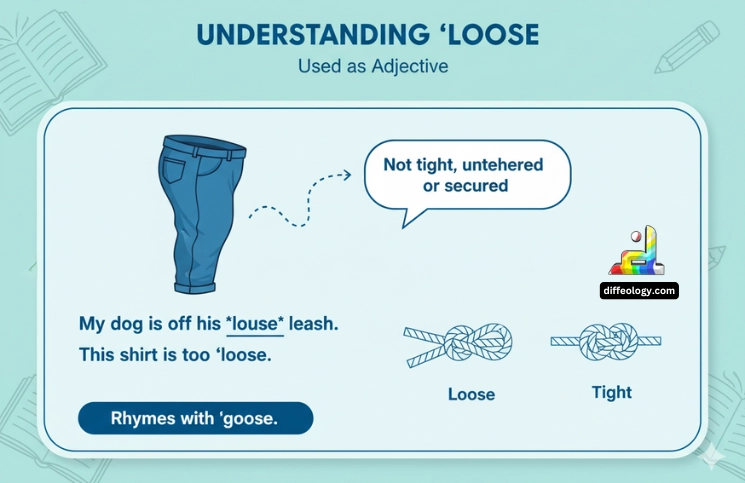
Loose is an adjective that is used for something that is not tightly or properly fastened, or is free to move. Examples of such things are “loose pants, ” “loose hair, ” or “loose handle.” If not tightly fastened or enclosed, the object is considered loose.
Additionally, it can also imply that the object is not strict or exact, such as “a loose plan” or “loose rules.” When talking about spelling, the word has five letters (l, o, o, s, e), with two o’s right in the middle, and it is still one syllable. It can be placed before the nouns (“loose gravel”) or after the linking verbs (“The knot is loose”), and it can change into related works like “loosen” (verb) and “loosely” (adverb). On a day- to, day basis, you will come across terms like “loose change” (coins) and “get loose” (become free) more frequently than others.
Read Also: Difference Between Among and Between
The way it is pronounced is straightforward: call “loos” and put an s at the end, not a z. Try to be aware of those fixed phrases as most of them illustrate its adjectival role: “loose cannon” (someone unpredictable), “loose ends” (unfinished parts), and “loose leaf” (single sheets in a binder).
A handy test is to see if it is possible to put words such as “very, ” “quite, ” or “too” in front of it: “very loose, ” “quite loose, ” “too loose” all are correct since adjectives can be modified by degree words. If you decide to go for verbs, “loosen the lid”, then it is the verb derived from the adjective that you are using. This little set (loose, loosen, loosely) is still about the idea of not being tight.
What is Lose?
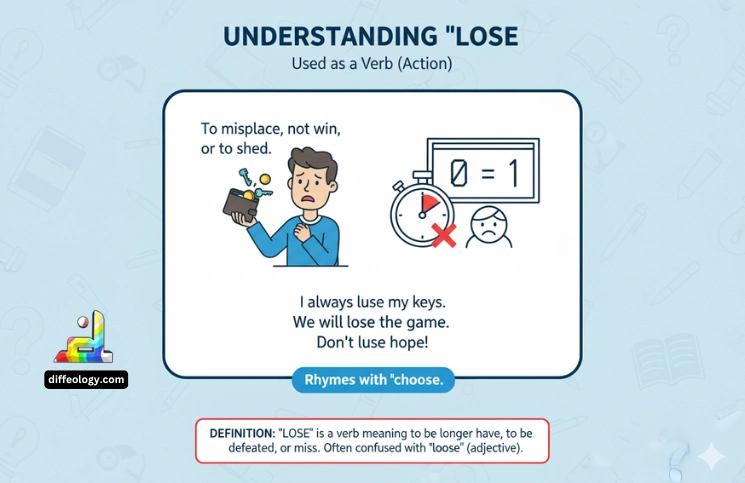
Lose is a verb that indicates an action: to fail to keep, to be defeated, or to stop having something. Some of the typical usages are “lose your keys, ” “lose a friend, ” “lose the game, ” “lose interest, ” and “lose time.” The word is spelled with four letters (l, o, s, e), having one o and a silent e at the end.
The final sound is a z, not an s. Watch the forms carefully: present “lose, ” third person “loses, ” past “lost, ” and, ing “losing.” As a verb, it can have direct objects (“lose money”) or be without objects when the idea is clear (“We will lose”).
Read Also: Difference Between Breath and Breathe
Moreover, “lose” can be found in such collocations as “lose weight, ” “lose touch, ” “lose sight, ” and “lose heart.” It is naturally compatible with outcomes and changes, and degree words like “very” or “too” cannot be used with it (you cannot say “very lose”).
Questions and negatives are formed with helping verbs: “Did we lose?” “We did not lose.” Writers sometimes confuse it with “loose” in “loose/lose weight, ” but the correct one is “lose weight, ” since the verb indicates the change. Remember “lose” for actions and results, and “loose” for states and descriptions.
Comparison Table “Loose Vs. Lose”
| Meaning | Not tight, free | Misplace, fail |
| Part of Speech | Adjective | Verb |
| Example | Loose shirt | Lose a game |
| Pronunciation | Rhymes with “moose” | Rhymes with “choose” |
| Common Context | Clothes, rules, bolts | Games, health, belongings |
Difference Between Loose and Lose in Detail
Get to know the Difference Between Loose Vs. Lose in Detail.
Part of Speech
Loose is an adjective, so it describes nouns: “loose screw,” “loose seat”; this lets it work with degree words (“very,” “too”) and sit before or after the noun (“The rope is loose”).
Lose is a verb, so it shows actions or outcomes: “lose keys,” “lose hope”; verbs change by tense (“lose,” “lost,” “losing”) and link to subjects and objects.
Meaning and Use
Loose points to “not tight,” “free,” or “not strict”: it tracks a state; you can spot fixed phrases like “loose ends” and “loose leaf” that keep this descriptive role.
Lose points to “fail to keep,” “be beaten,” or “stop having”: it tracks an action or result; phrases like “lose a match” and “lose signal” show change.
Pronunciation and Sound
Say “loose” like “loos” with an s sound at the end; it stays 1 syllable and has a long oo in the middle.
Say “lose” like “looz” with a z sound at the end; also 1 syllable with a long oo, but that end sound changes the word.
Spelling Patterns
Loose has 2 o’s before s (l-o-o-s-e); that double-o marks the adjective; related forms: “loosen,” “loosely.”
Lose has 1 o, then s, then final e (l-o-s-e); related forms: “loses,” “lost,” “losing.”
Grammar and Collocations
Loose fits noun phrases and linking verbs: “loose lid,” “The tie is loose,” “keep it loose”; it mixes with degree words easily.
Lose fits object patterns: “lose money,” “lose patience,” “lose direction”; it mixes with time and result words (“finally lose,” “always lose”).
Common Errors and Impact
Mixing “loose/lose” often occurs in health phrases (“lose weight” vs “loose weight”); picking the wrong one changes meaning or looks unprofessional in school or work.
Spell-check ideas: if you can replace it with “not tight,” use “loose”; if you can replace it with “misplace” or “be defeated,” use “lose.”
Memory Tricks and Tests
Adjective test: try “very”; “very loose” works, so the adjective is right; count letters: adjective has 5 letters and 2 o’s.
Verb test: try tense change; “lose/lost/losing” works, so the verb is right; action ideas (“to lose”) pick the single o + final e.
Key Difference Between Loose and Lose
Here are the key points showing the Difference Between Loose Vs. Lose.
- Form: Adjective vs Verb: Loose describes; lose acts. If it tells a state, use the adjective; if it shows change, use the verb.
- Letter Count: “Loose” has 5 letters; “lose” has 4. The extra o marks the adjective.
- Ending Sound: “Loose” ends with s; “lose” ends with z. Say “loos” vs “looz.”
- Degree Words: You can say “very loose”; you cannot say “very loose.” Degree words point to adjectives.
- Tense Forms: “Lose” changes by tense: lose, loses, lost, losing. “Loose” does not take tense; it takes “loosen” for action.
- Common Phrases:”Loose ends,” “loose change” vs “lose weight,” “lose a game.” The phrase list hints at the right choice.
- Meaning Core:”Loose” = not tight/free. “Lose” = fail to keep/be defeated.
- Object Use: Verbs take objects: “lose keys.” Adjectives modify nouns: “loose keys” means the keys are not tight (odd phrase).
- Test Word Swap: If “not tight” fits, choose “loose.” If “misplace” fits, choose “lose.”
- Spelling Check:Double o for “loose”; single o for “lose” plus silent e.
- Syllable Count: Both are 1 syllable, but the end sound differs; listen for s vs z.
- Related Forms: “Loosen,” “loosely” relate to “loose.” “Lost,” “losing” relates to “lose.”
- Verb Objects vs Noun Targets: “Lose patience” (object) vs “loose patience” (adjective wrongly used).
- Collocation Patterns: Adjectives collocate with nouns; verbs collocate with objects and results; patterns sort the choice fast.
FAQs: Loose Vs. Lose
Conclusion
In everyday English, you save time and avoid mistakes by linking form to role: loose (adjective, 5 letters, s ending) tells you something is not tight, while lose (verb, 4 letters, z ending) shows an action like misplacing or being defeated; sound cues matter too—”loos” versus “looz”—and quick checks help: try “very” for adjectives and tense change for verbs; common phrase banks hint the right word fast: “loose ends” vs “lose focus”; students who use these patterns fix most mix-ups in under 30 seconds and hit above 95% accuracy in homework and texts; repeating the memory trick—double o for the adjective, single o + e for the verb—keeps writing sharp, and knowing the difference between loose and lose makes sentences strong and easy to read.

