

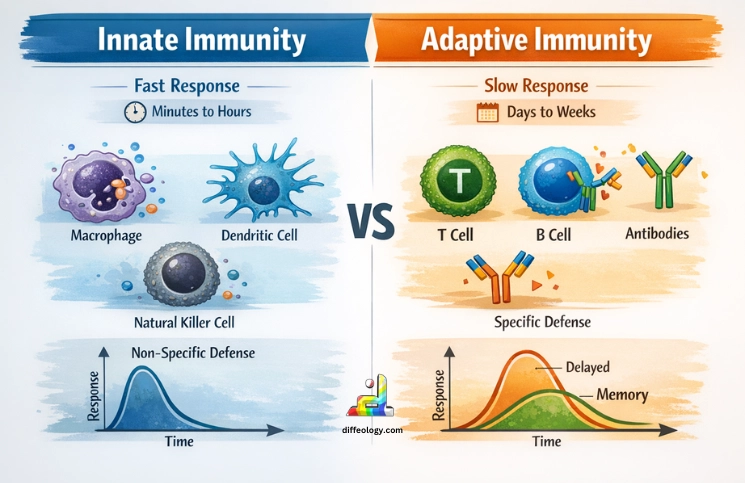
The difference between innate and adaptive immunity is about how fast the body fights germs and whether it remembers them. Innate immunity works right away using barriers like skin and mucus, plus cells that attack many germs the same way. Adaptive immunity takes longer to start but makes special cells that target one germ and remember it for next time.
When a new bug appears, innate defenses act in minutes to hours to slow it down, while adaptive immunity may take days to weeks to build strong, specific protection. Vaccines train adaptive immunity so people get long-lasting help; many vaccine programs have cut disease by large percentages in whole communities. Scientists use tools such as ELISA, PCR, flow cytometry, electronic health records, surveillance systems, registries, surveys, and statistical models to study both systems and to check how well vaccines and treatments work.
Main Difference Between Innate and Adaptive Immunity
The main difference is speed and memory. Innate immunity acts in minutes to hours and gives a general defense that works the same way for many germs. It usually takes several days or even weeks for the immune system to craft a precise response, yet it leaves behind memory cells that speed things up if the invader returns. Right away, the body’s first line blocks pathogens, sounding alarms to bring backup. Learning the exact structure of an intruder allows tailored defenses to form, crafting proteins that lock onto threats while storing details for later.
When both branches team up, immediate barriers buy time by holding off invaders, giving the slower, smarter part a chance to prepare. Future infections often fail to take hold because past encounters taught the system how to respond sooner.
Innate Immunity Vs. Adaptive Immunity
What is Innate Immunity
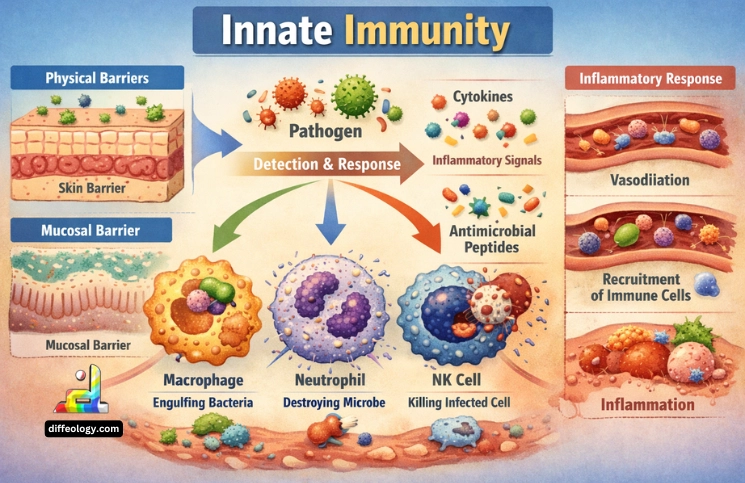
Right away, your body relies on innate immunity – something present from birth. Skin, mucus, even stomach acid – they form shields against invaders. Speed matters: certain cells jump into action quickly when threats appear. Neutrophils and macrophages move in, grabbing onto harmful microbes. They engulf what they catch, stopping problems before they spread. Blood proteins lend a hand by tagging troublemakers clearly. The complement system helps highlight targets for these defenders. Responses kick off within minutes or stretch to hours. Repeated contact with one germ doesn’t sharpen this reaction. It stays just as strong – or weak – as the first time.
Read Also: Difference Between Cold and Allergies
Right from the start, the body sounds an alarm through innate defenses, sparking swelling that pulls extra fighter cells toward trouble spots. That rush slows down invaders trying to move deeper into tissues. Pieces of broken-up microbes then get held up like flags by some frontline units, training the backup forces to recognize exact threats. To track these early reactions, researchers turn to methods including lab tests measuring proteins, gene copying counts, cell scanners, outbreak tracking networks, digital patient files, and number-crunching forecasts – watching both speed of defense and how widely illness spreads in crowds.
What is Adaptive Immunity
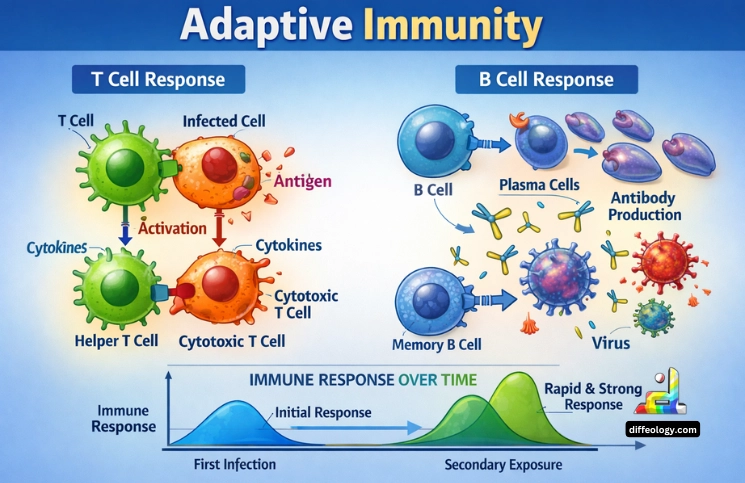
When the body faces a new invader, it doesn’t act fast right away. Learning happens slowly through experience, stored for later. B cells step in by crafting proteins that tag enemies. Alongside them, T cells either destroy compromised cells or assist teammates. While this system takes time – sometimes many days – it builds lasting memory. After that, the system makes memory cells that act faster and stronger on repeat exposure. This memory is why vaccines work and why many people do not get sick again from the same germ.
Read Also: Difference Between Active and Passive Immunity
Adaptive immunity is very specific. Antibodies fit a germ like a key fits a lock. When many people in a community have adaptive immunity, the spread of disease falls and outbreaks shrink. Scientists measure adaptive responses with antibody tests, T cell assays, and long-term follow up in registries, surveys, electronic health records, and with lab tools like ELISA, flow cytometry, and PCR.
Comparison Table “Innate Vs. Adaptive Immunity”
| Speed | Minutes to hours | Days to weeks |
| Specificity | Broad | Specific |
| Memory | No | Yes |
| Main cells | Neutrophils; macrophages | B cells; T cells |
| Common tests and tools | ELISA; PCR; flow cytometry | Antibody tests; flow cytometry; registries |
Difference Between Innate and Adaptive Immunity in Detail
Get to know the Difference Between Innate Vs. Adaptive Immunity in Detail.
Speed and Timing
Innate acts in minutes to hours and gives a quick, general defense. It uses barriers and cells that attack many germs the same way. This fast action can slow an infection early and reduce how many people get very sick. Adaptive takes days to weeks to build a specific response the first time. It is slower at first but becomes faster on repeat exposure because of memory cells. Adaptive speed gives long-term control and better targeting of the exact germ.
Specificity and Targeting
Innate is broad and treats many germs with the same tools. It does not tell one germ from another in detail. This helps when a new or unknown germ appears. Adaptive is specific and targets one germ type with tailored antibodies and T cells. This precision lets adaptive immunity neutralize a germ very well and stop it from causing harm.
Memory and Lasting Protection
Innate has little or no memory; it responds the same way each time. Its protection is short. Adaptive creates memory cells that can last months, years, or even a lifetime for some infections. Memory makes the second response faster and stronger, which is the basis for vaccines and long-term protection.
Main Cells and Molecules
Faster off the mark, innate immunity leans on neutrophils, macrophages, natural killer cells, along with proteins including complement. Skin, mucus – those barriers chip in too. Speed matters here; they team up to stall invaders early. Meanwhile, adaptive rolls out later with B cells crafting antibodies, while T cells either wipe out compromised cells or guide fellow defenders. Clues from innate activity shape how adaptive reacts, plus prior contact with microbes steers its response.
What Vaccines do for Community Well-being
Most times, vaccines prepare the body’s learned defense system to remember threats and create protective proteins. A small, harmless part of a microbe is introduced, allowing certain immune cells to study it safely. When enough people get shots, sickness rates often drop sharply across communities. The body’s first-line defenders assist by showing pieces of the invader to specialized units, plus triggering alerts that fire up protection. Health strategies mix these approaches – using jabs to build long-term readiness, while daily habits like cleanliness and covering coughs strengthen immediate barriers.
How They Shape Disease Patterns
When the body fights fast at first, fewer folks land seriously ill during a new outbreak. Because past exposures train immunity, later surges often hit weaker than before. Infections that vanish quickly might never reach the stage where lasting memory matters much. When bugs stick around or return often, remembering them makes all the difference down the line. One system acts now, the other guards what comes after – both decide illness depth, duration, and strain on clinics.
How Scientists Measure and Study Them
Measuring natural immune reactions means checking cytokines and cell behavior through methods like ELISA, flow cytometry, or PCR when looking for pathogens. To catch signs of illness early in groups, researchers lean on monitoring networks, questionnaires, plus digital medical files. When it comes to adaptive immunity, they look at antibodies, run T cell analyses, then keep tabs over time using patient logs along with number-crunching techniques that show how protection holds up post-illness or shot. With these approaches, vaccine creation gets clearer, care planning improves, while forecasting disease movement becomes possible.
Key Difference Between Innate and Adaptive Immunity
Here are the key points showing the Difference Between Innate Vs. Adaptive Immunity.
- Speed — Innate acts in minutes to hours; adaptive acts in days to weeks. Innate is fast; adaptive is slower at first.
- Specificity — Innate is broad; adaptive is specific. Adaptive targets one germ well.
- Memory — Innate has little memory; adaptive makes memory cells. Memory helps prevent repeat illness.
- Main cells — Innate uses neutrophils and macrophages; adaptive uses B cells and T cells. Each group has different jobs.
- Role of vaccines — Vaccines train adaptive immunity. Vaccines make memory without causing disease.
- Measurement — Innate measured by cytokines and cell tests; adaptive by antibodies and T cell tests. Different tests show different parts of the response.
- Effect on outbreaks — Innate slows early spread; adaptive reduces future waves. Both help control disease.
- Duration of protection — Innate protection is short; adaptive protection can be long. Long protection lowers repeat infections.
- Type of defense — Innate is physical and chemical barriers plus cells; adaptive is cellular and antibody based. Barriers stop entry; antibodies neutralize germs.
- Training — Innate is not trained by vaccines; adaptive is trained. Vaccines focus on adaptive memory.
- Complexity — Innate is simpler and fast; adaptive is complex and precise. Complexity gives better targeting.
- Population impact — Adaptive immunity in many people lowers spread in the community. Herd effects depend on adaptive memory.
- Clinical use — Innate markers guide early treatment; adaptive markers guide vaccine policy. Doctors use both to make choices.
- Research tools — Scientists use ELISA, PCR, flow cytometry, surveillance systems, electronic health records, registries, surveys, and statistical models to study both systems.
FAQs: Innate Immunity Vs. Adaptive Immunity
Conclusion
Using the difference between innate and adaptive immunity helps health workers and students know when to act fast with innate tools and when to build long-term protection with adaptive memory so people and communities stay safer.
References & External Links
- Innate Immune System Detail
- Adaptive Immune System Detail

