

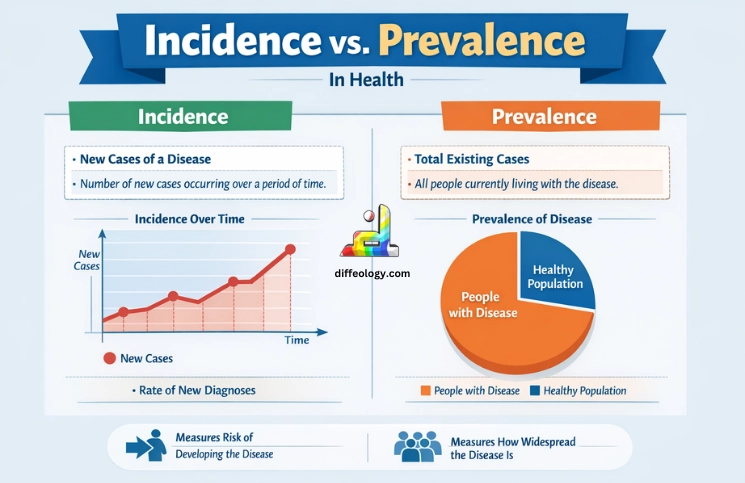
The difference between incidence and prevalence is about time and counting. New cases appearing within a specific group over a defined stretch make up what we call incidence. All individuals holding the condition at a single moment, or just recently, form the count known as prevalence. In 2021, roughly 1.5 million folks received an HIV diagnosis – this stands as an incidence measure. Yet far more people were already carrying HIV, which reflects the broader snapshot captured by prevalence.
When health workers track whether something spreads faster, they turn to incidence data. But when figuring out clinic size, medicine stock, or hospital space, they lean on prevalence instead.
Main Difference Between Incidence and Prevalence
Here’s what sets them apart: one counts new cases during a stretch of time, the other tallies who has it right now. When an illness spreads fast but ends quickly, fresh diagnoses pile up even if few have it at once. Long-lasting conditions might not bring in many new patients, yet plenty still carry it. Knowing both helps teams on the ground decide where to act. That detail matters just as much as the rest.
Incidence Vs. Prevalence
What is the Incidence?
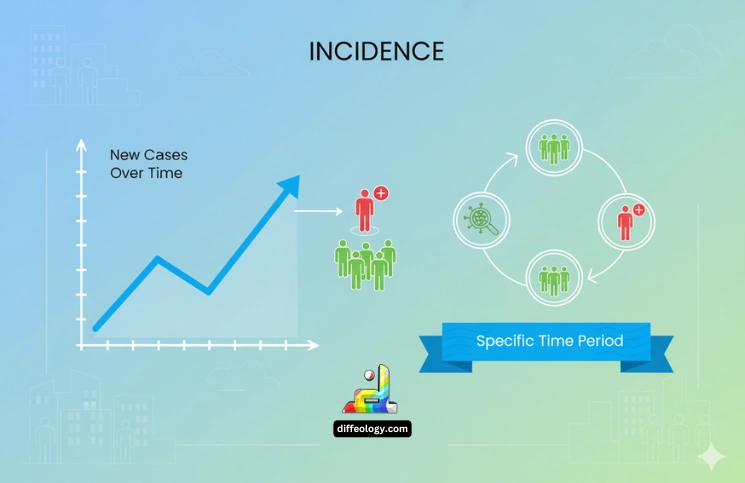
Imagine counting fresh cases popping up in a crowd over months or years. That count is called incidence. Think of it like this: split the number of newcomers with illness by everyone who could catch it – that’s one way to picture risk. Or tally each case against total time lived by all – this shapes a rate. Take 2021, when around 1.5 million faced a certain sickness amid nearly 8 billion souls on Earth. This slice hints at that year’s scope. Spotting surges lean on such numbers. Progress in shielding folks also hides within these figures.
Starting fresh means counting only those without the illness at first. A fixed period – say, twelve months – keeps things sharp. Sources such as tracking programs, official logs, or questionnaires tend to give solid numbers. When it comes to asking if danger is rising or who faces greater odds, this method hits closest to truth.
Read Also: Difference Between Cold and Allergies
A drop in numbers after rollout might mean things are working. When fresh cases go down, it points toward progress. One area can look different from another – patterns show up through new infections. Seeing how fast people get sick tells a story across regions.
What is Prevalence?
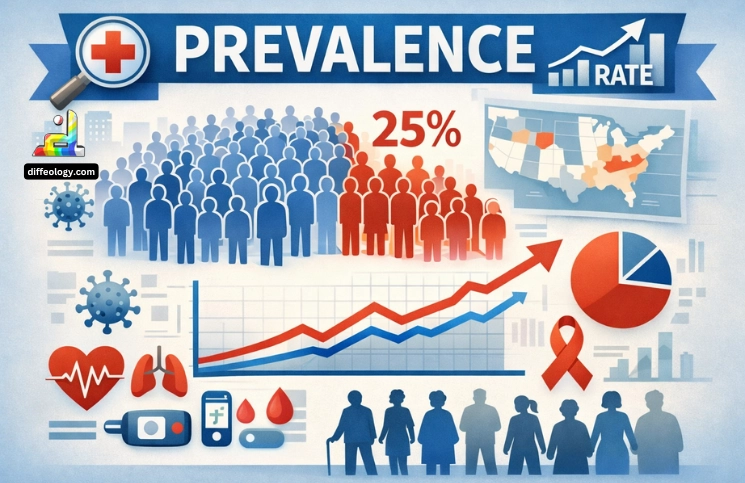
Counting everyone with a health issue during a set moment gives point prevalence. That snapshot tells how widespread it is right then. Looking across weeks or years captures period prevalence instead. The question behind this measure: what number of individuals are affected today? Numbers often appear as percentages or within every one hundred thousand souls. When rates climb, either more folks are getting sick or survival with the illness has stretched out.
How common a disease is ties closely to how often it appears plus how long folks remain unwell. Staying ill for months or years lifts those numbers, regardless of fresh diagnoses. Take diabetes – lasting decades means more people carry it at any time. Short bugs such as influenza pass fast, so fewer are sick at once, despite being widespread each winter.
Read Also: Difference Between Active and Passive Immunity
Figuring out what’s needed often starts with counting who’s affected. Surveys might show it, but so can computer estimates or doctor visits logged digitally. Today’s numbers tell us the size of the situation – also, how many folks require help right now
Comparison Table “Incidence Vs. Prevalence”
| What it counts | New cases | All existing cases |
| Time frame | Over a period | Point or period |
| Shown as | Per person-time; risk | Percent; per 100,000 |
| Main use | Track spread; detect outbreaks | Plan services; show burden |
| Affected by duration | No | Yes |
Difference Between Incidence and Prevalence in Detail
Get to know the Difference Between Incidence Vs. Prevalence in Detail.
1. What each one counts
Incidence counts only new cases that start in a set time. It needs a group that was free of the disease at the start. Prevalence counts all cases at a time, both new and old. It gives a snapshot of how many people are affected now.
Incidence needs tracking over time. Prevalence needs a good survey or record at a point in time. Both are useful but answer different questions.
2. Time and measurement
Incidence may employ person-time for precision and may use a time frame, like one year. A measure of point or period prevalence does not call for person-time. Incidence shows how quickly new cases come since it uses time. Prevalence reveals how many people now have the illness.
Incidence is the indicator of the quicker rate of propagation of a sickness. Prevalence can tell you how many people need services right now.
3. Use in public health
Incidence helps detect outbreaks and measure risk. It is useful for testing prevention and vaccines. Prevalence helps plan health services, medicines, and long-term care. Incidence guides actions to stop new cases. Prevalence guides actions to help people who already have the disease.
Both numbers together give a full picture for policy and planning.
4. Effect of disease duration
Incidence is not affected by how long people live with the disease. Prevalence rises when people live longer with the disease. Chronic diseases with long duration often have high prevalence even if incidence is low. Short illnesses can have high incidence but low prevalence.
This is why diabetes can have high prevalence while a short infection may not.
5. Data needs and ease of measurement
Incidence needs follow-up or good reporting over time, which can be hard in weak systems. Prevalence can be measured with a single survey or registry at one time, which is often easier. However, prevalence can miss trends that incidence shows. Incidence needs more effort but gives trend data.
Good data systems like electronic health records and surveillance systems make incidence measurement easier.
6. Interpretation and policy signals
Less fresh cases follow from a decreased incidence. A lower incidence could point to quicker recovery, higher mortality, or fewer newly diagnosed cases. High prevalence with low incidence implies either chronic disease or prolonged survival. High incidence combined with low prevalence suggests a brief course of illness.
Policymakers should read both datasets to avoid wrong conclusions.
7. Examples that show the difference
Though seasonal flu’s incidence can be high in a season, low point prevalence results from patients recovering rapidly. Diabetes has a low occurrence but high prevalence since people live many years with it.
These illustrations help to explain why both approaches are important for various decisions.
Key Difference Between Incidence and Prevalence
Here are the key points showing the Difference Between Incidence Vs. Prevalence.
- Formula: Incidence uses new cases and population at risk; prevalence uses total cases and total population. Incidence may use person-time; prevalence is usually a percent.
- Affected by duration: Prevalence rises with longer disease duration; incidence does not. Long survival increases prevalence even if incidence is low.
- Data needs: Incidence needs follow-up; prevalence needs surveys or records. Incidence is harder to measure without good systems.
- Outbreak detection: Incidence detects outbreaks quickly. Prevalence may lag and not show sudden rises.
- Service planning: Prevalence helps plan clinics, medicines, and beds. Incidence helps plan prevention programs.
- Units: Incidence often per person-year; prevalence as percent or per 100,000. Both can be scaled to make numbers easy to read.
- Trend vs size: Incidence shows trend; prevalence shows size. Trend helps judge if control measures work.
- New vs all: Incidence = new cases; prevalence = all cases. Incidence counts only those who became sick in the time window; prevalence counts everyone sick at the time.
- Time window: Incidence needs a time period; prevalence is a snapshot. You must pick a clear time for incidence; prevalence is measured at a point or over a short period.
- Purpose: Incidence for risk and trends; prevalence for burden and planning. Use incidence to test prevention; use prevalence to plan services.
- Chronic vs acute: Chronic diseases → high prevalence; acute diseases → high incidence. This affects how health systems respond.
- Interpretation caution: Both must be read together for a full picture. One number alone can mislead.
- Policy use: Incidence guides prevention policy. Prevalence guides resource allocation.
- Communication: Incidence is used in reports about risk; prevalence is used in reports about burden. Clear messages need both numbers.
FAQs: Incidence Vs. Prevalence
Conclusion
Knowing the difference between incidence and prevalence is vital. It helps health teams determine whether to care for those already afflicted with the disease or to halt new cases, therefore guiding their actions and efficient resource use.
References & External Links
- Incidence Rate: Definition, Calculation, and Examples
- Prevalence Rate – an overview

