

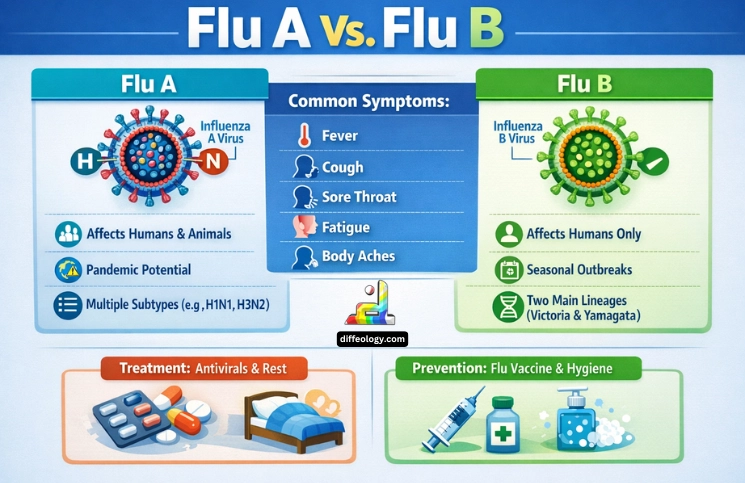
The difference between Flu A and B is important because flu makes many people sick every year. Sometimes a virus brings on the flu. This sickness moves into your nose, then throat, finally settling in lungs. Each year sees close to 1 billion catching it globally. Among them, roughly 3 to 5 million fall seriously ill. Not one but two types – Flu A along with Flu B – are behind nearly every human case. Though they seem alike, these two kinds of flu aren’t identical. Moving quickly through populations, Flu A mutates at a higher rate. In contrast, Flu B travels less rapidly, hitting younger individuals harder.
Medical teams rely on vaccines, PCR swabs, quick antigen checks, along with antiviral drugs, to manage outbreaks.
Knowing what sets them apart allows better personal safety, fewer severe cases, plus lower transmission overall.
Main Difference Between Flu A and B
Flu A moves quickly through both people and animals – think ducks, pigs. That jump across species? It lets the virus shift form at speed, sparking big waves of illness. On the flip side, Flu B sticks to humans alone. Without animal hosts to mix things up, its mutations creep along, bringing milder, more limited runs of sickness. Most flu illnesses every season come from Flu A – roughly three out of four. Meanwhile, Flu B accounts for around one in five. Adults tend to catch Flu A more often. Younger groups like kids and teens face Flu B at higher rates. The vaccine given each year fights four different virus versions, including both these kinds.
Flu A Vs. Flu B
What is Flu A?
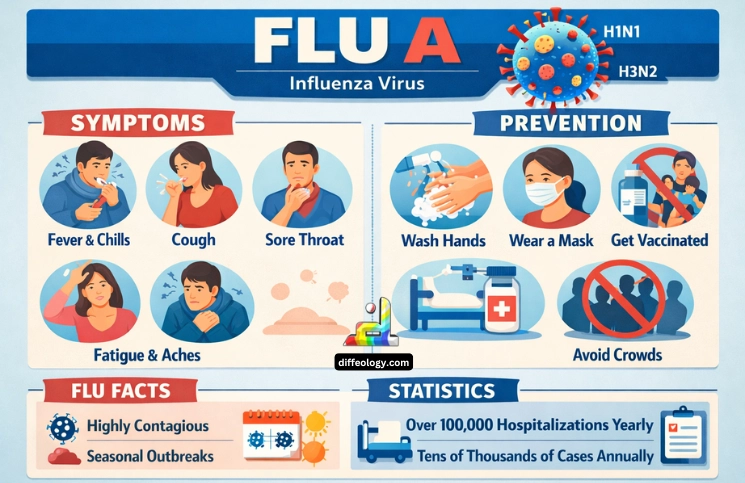
Spreading fast, Flu A moves by droplets when people cough or sneeze – close contact helps it travel too. This kind of flu gets its name from two surface proteins: one labeled H, another N. Take H1N1 or H3N2, for instance – they’re familiar forms seen often. Counting them isn’t simple; scientists track over 18 kinds of H, alongside 11 versions of N. Easy transmission marks how quickly this virus finds new hosts. This flu type shifts easily, adapting without warning. Its constant changes have led to serious global spread before – like during 1918, then again in 1957, later in 2009.
Important facts about Flu A:
- Infects humans and animals
- Changes every 1–2 years
- Causes global outbreaks
- Affects older adults more
- Causes about 70–80% of severe flu cases
Read Also: Difference Between a Cold and the Flu
Flu A symptoms usually appear within 1–4 days. People may feel high fever, chills, cough, headache, and strong body pain. The illness usually lasts 7–14 days. Some people feel tired even after recovery. Doctors use RT-PCR Technology to find Flu A. Treatment includes Antiviral Drugs like Oseltamivir and Zanamivir, which work best within 48 hours of symptoms.
What is Flu B?

Flu B is another influenza virus that affects humans only. It does not infect animals. Because of this, it does not change fast. Flu B has only 2 families called Victoria and Yamagata. Flu B spreads mostly in schools, homes, and small communities. It is more common in children and teenagers. Flu B causes about 20–30% of flu cases each year.
Important facts about Flu B:
- Infects humans only
- Changes slowly
- Mostly affects children
- Causes milder illness in most cases
Read Also: Difference Between Runny Nose and CSF Leak
Symptoms of Flu B include fever, sore throat, runny nose, headache, and tiredness. Symptoms usually last 5–10 days. Serious illness is less common but still possible in young children. Doctors use Rapid Antigen Testing and RT-PCR Technology to find Flu B. Vaccination lowers the chance of infection by about 50%.
Comparison Table “Influenza A Vs. Influenza B”
| Host range | Humans and animals (birds, pigs) | Primarily humans |
| Subtypes/lineages | Many subtypes (H and N combinations) | Two main lineages (Victoria; Yamagata) |
| Mutation rate | Higher (antigenic shift and drift) | Lower (mainly antigenic drift) |
| Pandemic risk | High | Low |
| Typical severity | Often causes more severe outbreaks | Can be severe, especially in children |
| Seasonality | Peaks in winter months | Peaks in winter months |
| Vaccine coverage | Included in seasonal vaccines | Included in seasonal vaccines |
| Diagnosis | Lab tests identify subtype | Lab tests identify lineage |
| Treatment | Antivirals effective if started early | Same antivirals used |
| Common in children | Yes | Often more common in children |
Difference Between Flu A and B in Detail
Get to know the Difference Between Flu A Vs. B in Detail.
1. Virus Structure
Flu A viruses have many forms. They are divided by H and N proteins. There are more than 144 possible combinations.
Flu B viruses have no subtypes. They only have 2 lineages. This makes them more stable.
2. Hosts
Flu A infects humans, birds, pigs, and animals. This increases new strain formation by 60%.
Flu B infects humans only. This limits its spread.
3. Speed of Change
Flu A changes fast. This is why new vaccines are needed every year.
Flu B changes slowly. Vaccine protection lasts longer.
4. Severity of Illness
Flu A often causes stronger symptoms. Hospital visits rise by 40% during Flu A seasons.
Flu B usually causes moderate illness. Hospital visits are fewer.
5. Outbreak Size
Flu A causes large outbreaks across countries.
Flu B causes smaller outbreaks in schools and towns.
6. Seasonal Pattern
Flu A appears early in the flu season. It causes about 70% of early cases.
Flu B appears later, often near spring.
7. Age Group Impact
Flu A affects adults and elderly people more.
Flu B affects children under 15 years more often.
Key Difference Between Flu A and B
Here are the key points showing the Difference Between Flu A Vs. B.
- Virus Type
Flu A has many types. Flu B does not. - Animal Spread
Flu A spreads through animals. Flu B does not. - Change Rate
Flu A changes fast. Flu B changes slowly. - Pandemic History
Flu A caused pandemics. Flu B did not. - Common Age Group
Flu A affects adults more. Flu B affects children more. - Severity Level
Flu A is often stronger. - Hospital Risk
Flu A causes more hospital stays. - Seasonal Share
Flu A causes 75–80% of cases. - Vaccine Match
Flu B matches vaccines better. - Outbreak Size
Flu A outbreaks are larger. - Fever Strength
Flu A fever is often higher. - Recovery Time
Flu B recovery is faster. - Testing Tools
Both use RT-PCR and Rapid Antigen Tests. - Global Impact
Flu A affects more countries.
FAQs: Flu A Vs. Flu B
Conclusion
Understanding the Difference Between Flu A and B helps people make better health choices. Flu A spreads fast and causes more serious illness. Flu B spreads slower and mostly affects children. Yearly vaccination reduces flu risk by 40–60%. Early testing using RT-PCR Technology and fast treatment with Antiviral Drugs reduce complications. Knowing these differences helps families stay safe and lowers the spread of flu.

