

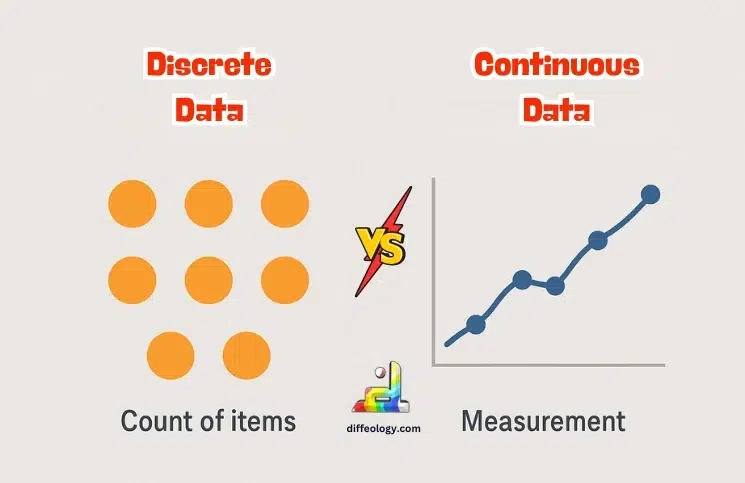
Every number we collect falls into one of 2 types: discrete or continuous. Quantitative variables cover 100 % of numeric data. Students learn this split as early as grade 6 in many curriculum’s. There is a big difference between discrete and continuous data. Discrete data can be counted. It has finite values. It cannot split into parts. Continuous data can be measured. It has an infinite number of fractional values between any two points. You count students, votes or cars. You measure height, weight or time. Bar graphs display discrete values. Line graphs or histograms display continuous data.
Knowing this helps you pick the right graph and method.
Main Difference Between Discrete and Continuous
Discrete data consists of countable, separate values. You can list each one. There are gaps between values. Continuous data consists of measurable values. You can find an endless series of numbers between any two points. Discrete variables use bar charts or pie charts. Continuous variables use histograms, line graphs or scatterplots. Discrete probability uses probability mass functions. Continuous probability uses probability density functions. Discrete data deals with whole numbers. Continuous data deals with real numbers and decimals.
Discrete Vs. Continuous Data
What is Discrete Data
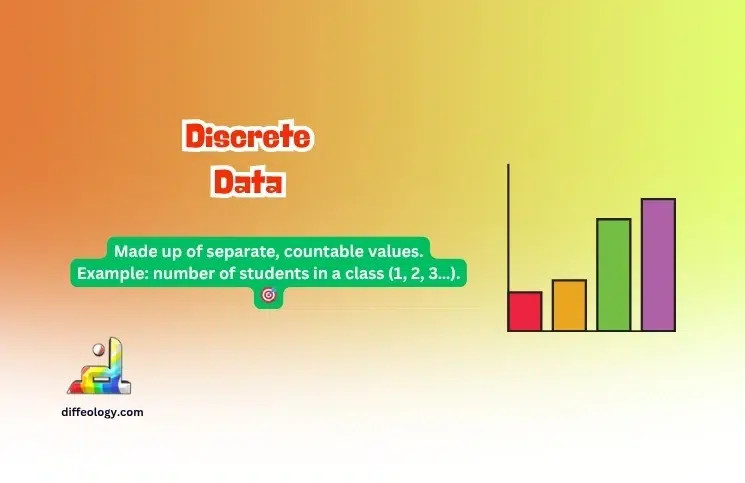
Discrete variables can only assume specific values that you cannot subdivide. These values are usually whole numbers. You count them. For example, you can have 12 cats but not 12.5 cats. Common examples include the number of books on a shelf, the number of heads in coin tosses, and the number of students in a class. Discrete data often appears as bar graphs. Each bar stands alone. The bars never touch.
Read Also: Difference Between Ounces and Pounds
Discrete data cannot have decimals for individual values. Each value is a separate point on the number line. You might count 0, 1, 2, but you never see 1.2 as a discrete data point. When you average discrete values, you can get fractions. For instance, the average family might have 2.2 children, even though each family has a whole number of kids.
What is Continuous Data
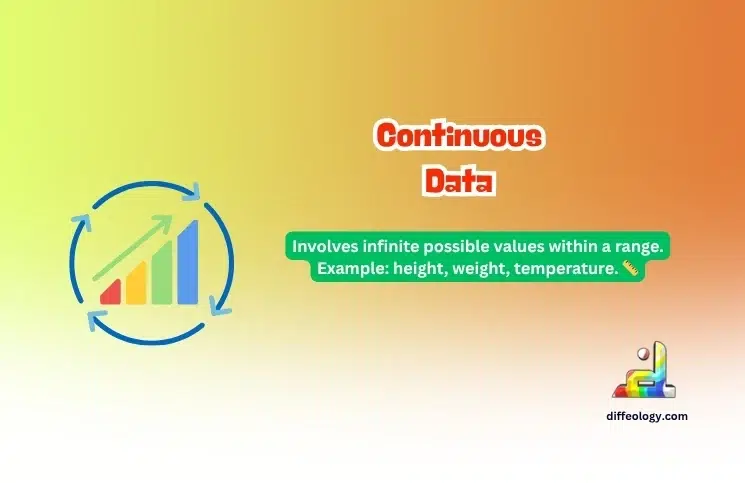
Continuous variables can assume any numeric value and can be meaningfully split into smaller parts. These values can include decimals and fractions. Continuous data has an infinite number of possible points between any two values. Examples include height, weight, time and temperature. You measure them on a scale. You can record 150.5 cm, 150.55 cm, 150.555 cm, and so on.
Read Also: Difference Between Data and Information
Continuous data often appears in histograms or line graphs. The bars or lines touch. The graph looks smooth. You see a curve that links all possible values. Continuous variables let you zoom in on smaller intervals. You can measure to the nearest tenth, hundredth or more for greater precision.
Comparison Table “Discrete Vs. Continuous Data”
| Nature | Countable, separate values | Measurable, any value in range |
| Values | Integers (0, 1, 2, …) | Real numbers with decimals |
| Measurement Method | Counting | Instruments (rulers, scales, timers) |
| Graph Type | Bar graph, pie chart | Histogram, line graph, scatterplot |
| Gaps | Present | None |
| Probability Function | Probability Mass Function (PMF) | Probability Density Function (PDF) |
| Examples | Number of students, dice outcomes | Height, weight, time |
| Statistical Tests | Chi-square, binomial distribution | t-test, ANOVA, regression |
Detailed Difference Between Discrete and Continuous Data
Get to know the Difference Between Discrete Vs. Continuous Data in Detail.
1. Nature of Values
Discrete data has specific, separate values. You cannot pick values between them. For example, you can count 3 or 4 cars, but not 3.5 cars. Continuous data has any value in a range. You can have 3.5 hours or 3.75 hours. There are no gaps between possible values.
2. Measurement vs Counting
You count discrete data. You tally items one by one, like books or votes. Each count increases by 1. You measure continuous data. You use tools like rulers, scales or timers. Measurements can vary by decimals, like 2.3 kg or 2.345 kg.
3. Graphical Representation
Discrete variables often use bar graphs or pie charts. The bars stand apart to show distinct values. Continuous variables often use histograms, line charts or scatterplots. The bars or points connect to show a spectrum.
4. Range of Data
Discrete data has a finite set of values. You can list them all, such as 0, 1, 2, …, up to a maximum. Continuous data has an infinite set of values between any two points. You cannot list all possible decimal values.
5. Examples
Discrete examples include number of students, outcomes of dice, or count of defective items. Continuous examples include temperature, height, weight, time or speed1.
6. Probability Functions
Discrete data uses a probability mass function (PMF) to assign probabilities to each value. Continuous data uses a probability density function (PDF). Probabilities cover intervals rather than exact values.
7. Statistical Methods
Discrete variables use counts in methods like chi-square tests and binomial distributions. Continuous variables use measures in methods like t-tests, ANOVA and regression analysis.
Key Difference Between Discrete and Continuous Data
Here are the key points showing the Difference Between Discrete Vs. Continuous Data.
- Count vs Measure Discrete data is counted. Continuous data is measured.
- Integer vs Real Discrete values are integers. Continuous values are real numbers.
- Gaps vs No Gaps Discrete data has gaps between points. Continuous data has no gaps.
- Bar vs Line Discrete data uses bar graphs. Continuous data uses line graphs or histograms.
- PMF vs PDF Discrete probability uses PMF. Continuous probability uses PDF.
- Finite vs Infinite Discrete data has a finite number of values. Continuous data has an infinite number of possible values.
- Examples – Discrete Number of cars, dice results, student count.
- Examples – Continuous Height, weight, time, temperature.
- Counting Increments Discrete increments are usually 1 Continuous increments can be as small as needed.
- Decimal Values Discrete data cannot have decimals for individual values. Continuous data can.
- Precision Discrete data has fixed precision. Continuous data precision depends on measurement tools.
- Probability Calculation Discrete uses summation of PMF. Continuous uses integration of PDF.
- Data Collection Discrete data is collected via counts or surveys. Continuous data is collected via instruments and sensors.
- Applications Discrete data suits inventory, polling and quality counts. Continuous data suits scientific measures, engineering metrics and financial prices.
FAQs: Discrete Vs. Continuous Data
Conclusion
Understanding the difference between discrete and continuous data guides how we collect, graph and analyze data. You know when to count or measure. You know when to use bars or curves. You know when to apply PMF or PDF. You know when to choose chi-square or regression. You handle numbers and decimals correctly. You respect measurement limits. With this knowledge, your data work gains accuracy and insight.

