

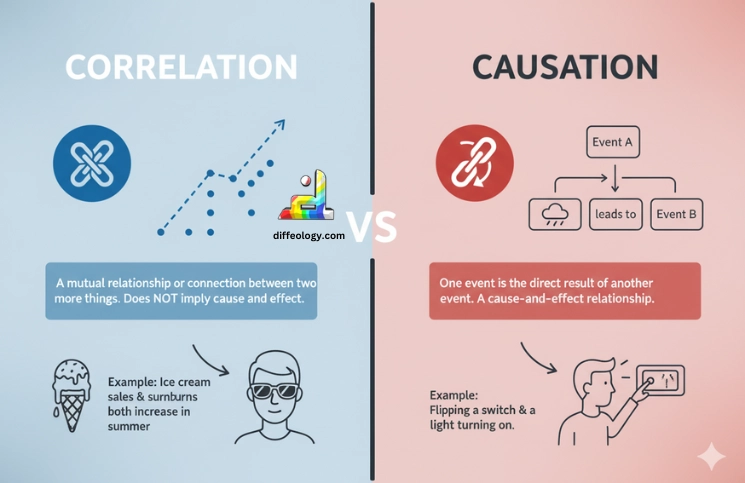
Correlation and causation are two concepts that are hardly ever distinguished by people, but they are still different. See the Difference Between Correlation and Causation here in detail. Correlation signifies that two things change in accordance with each other, while causation means that one thing directly causes another to happen.
The failure to understand these concepts can cause mistakes in fields such as science, medicine, economics, and even in the daily life of a person. More than 70% of people, according to surveys, take correlations as causes, and in 90% of medical studies that highlight correlations, only 30% prove causation. The difference between these numbers is the main reason why the knowledge of the difference is so crucial.
Using technologies like SPSS, R, Python, Excel, and SQL, researchers are able to easily measure correlations, but establishing causation requires an experiment, a randomized trial, and a more in-depth analysis. Knowing this difference from us helps to keep away from fake conclusions, to decide better, and to trust the evidence that is really important.
Main Difference Between Correlation and Causation
Correlation refers to the situation where two variables change together, whereas causation refers to one variable changing the other directly. For instance, smoking and lung cancer are causally linked, while the shoe size and the reading ability of children are only correlated due to age. Simply put, correlation deals with the connection between variables, while causation deals with the cause and effect relationship.
Correlation Vs. Causation
What is Correlation?
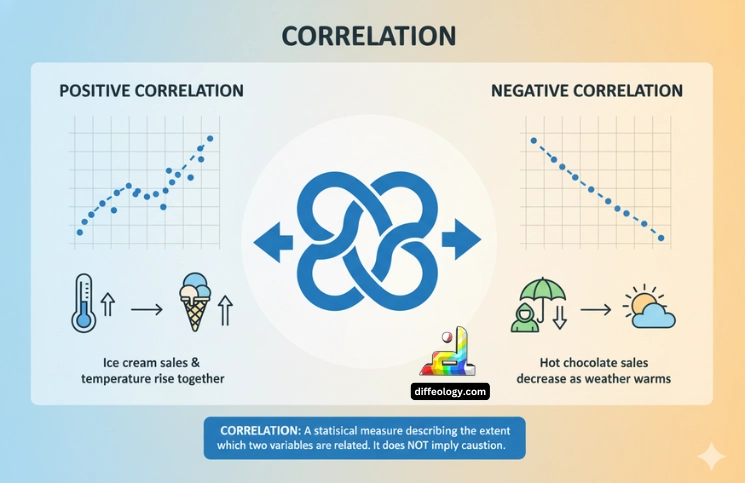
Correlation is one of the concepts that explains the relationship between two variables. Positive correlation is when both variables increase. Negative correlation is when one increases and the other decreases. Height and weight, for example, generally have a positive correlation. The correlation coefficient in statistics varies from -1 to +1, where +1 denotes perfect positive correlation and -1 denotes perfect negative correlation.
Correlation finds a lot of uses in research, economics, and natural sciences. For example, economists discovered a correlation coefficient of 0.85 between income and education level, which signifies that one usually leads to the other. However, correlation alone cannot determine the cause. This is the reason why in some cases the third factor exists. A good instance of such a scenario is the simultaneous increase in ice cream sales and sunburns that is caused by the rise in temperature. To find, analyze, and draw the correlation coefficients and relevant graphs many people use software such as SPSS, R, and Excel.
Read Also: Difference Between Tunic and Blouse
The main reason why correlation is considered a valuable tool is due to the fact that it enables the prediction of trends. Thus, if there exists a compelling correlation between the factors rainfall and crop yield, farmers will be able to make better plans. However, correlation may still lead to deceives. One of the most famous examples is the correlation between the number of movies that Nicolas Cage has acted in and the number of people who drowned in swimming pools. Whilst the correlation was very strong, the two were obviously unrelated. This is a demonstration of why people need to be careful when dealing with correlation.
What is Causation?
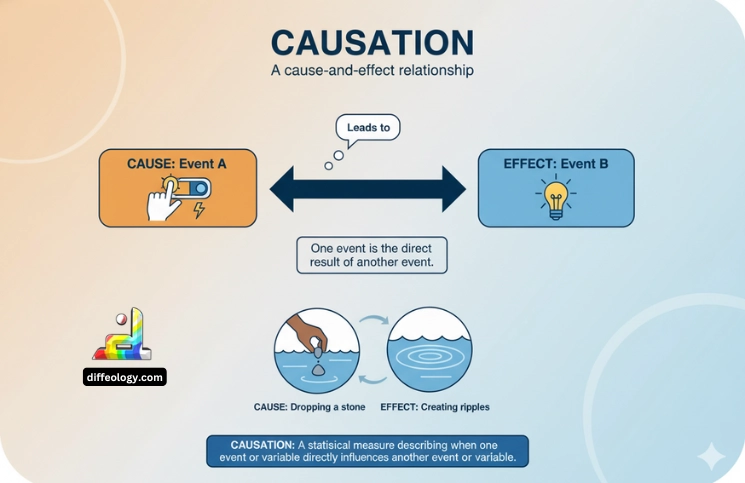
Causation refers to the situation where one event directly causes another. A good example would be smoking, which has been shown to cause lung cancer through medical research spanning over a long period of time. In contrast to correlation, determination of causation demands evidence in the form of experiments or a solid body of proof that changes in one factor lead to changes in another. To support this idea, in science, the proving of cause includes the use of randomized controlled trials.
One of the reasons why causation is powerful is because it shows what the outcomes will be. The direct implication of this is that if people use seatbelts, deaths due to car accidents will go down by 45%, which illustrates a very clear cause effect relationship. Similarly, vaccines help reduce disease rates by over 80%, which is the proof of a causal relationship. In the absence of causation, making the strongest claims of what really works becomes impossible. Even though technologies such as Python, SQL, and R help in analyzing huge datasets, controlled experiments along with precision in design are still indispensable when it comes to proving causation.
Read Also: Difference Between Hair Relaxing and Rebonding
Causation plays a vital role in the field of economics as well. A case in point would be the direct impact of cigarette tax hike in the reduction of smoking. This is not simply correlation but rather causation as evidenced by policy studies. In the realm of medicine, causation is like a spine that supports the basis for treatment decisions. Doctors use causation as a reference when they write prescriptions, reassuring that the reduction of symptoms or cure of the disease is what will follow.
Comparison Table “Correlation Vs. Causation”
| Meaning | Association | Direct effect |
| Proof | Observations | Experiments |
| Direction | Unclear | Clear |
| Examples | Ice cream & sunburn | Smoking & cancer |
| Use | Prediction | Policy & medicine |
Difference Between Correlation and Causation in Detail
Get to know the Difference Between Correlation Vs. Causation in Detail.
-
Definition
Correlation is the measure of the way two variables change together, either positively or negatively. In contrast, causation is that direct association which shows one factor changing another. For example, the fact that taller people are generally heavier is an instance of correlation, whereas the case where smoking is directly increasing the risk of lung cancer is an example of causation. Causal concepts deal with the world of causes, whereas correlations are about the regularities in data, and this is why causation is much more powerful when it comes to science and decision making.
-
Evidence
Correlations can be detected through questionnaires, observations, and statistical studies; more often than not, one uses tools such as SPSS, Excel, or R to get correlation coefficients. On the other hand, causation demands a demonstration through an experimental setup, clinical trials, or solid scientific evidence indicating that variation in one factor brings about the change in another. To illustrate, a 0.85 correlation between education and income indicates a strong relationship, but causation linking education with increased income is only established through long-term studies. This difference in proofs is the reason why people consider causation to be more difficult but also more convincing when decisions are made.
-
Directionality
Correlation does not indicate which variable causes the change of the other, whereas causation points to the effect direction explicitly. For instance, the correlation between shoe size and reading skills is due to the fact that both variables are influenced by age, as older children naturally have bigger feet and are more capable of reading. Correlation is a way of showing movement, while causation is the pointer indicating the influence direction. Without direction, correlation has a potential to deceive, while causation reveals which factors really bring about change.
-
Third Variables
Correlation might be explained by a third variable, whereas causation dismisses other interpretations via experiments. For instance, there is a positive correlation between ice cream sales and sunburns, but the actual reason behind it is hot weather, which causes both to rise. This is a type of spurious correlation where two variables seem to be interconnected but in reality, they are both influenced by a third. Causation, hence, gets rid of these hidden variables by demonstrating that one variable is directly influencing the other, therefore, it is much more reliable.
-
Strength of Relationship
Correlation can be either strong or weak, and its magnitude can be quantified by coefficients, which may take values from -1 to +1; on the other hand, causation is absolute, i.e., one thing directly influences another. A +1 correlation means that the two variables move together in a perfect positive manner, whereas a -1 correlation denotes that the variables move in a perfect negative way, but none of them imply a causal relationship. Causation, however, is about assurance: if the statement “smoking causes lung cancer” is true, then the reduction in smoking will lead to the reduced risk of lung cancer. The intensity of correlation is a matter of numbers, while the degree of causation is a matter of evidence.
-
Examples
Correlation can sometimes show weird or funny patterns, such as divorces being associated with margarine consumption, which is purely random but measurable. On the contrary, causation is tough and trustworthy, like the example where it is demonstrated that wearing seatbelts cuts down fatal injuries in car accidents by 45% or vaccines leads to a decrease in disease incidence by over 80%. These examples illustrate that correlation can be used to reveal the patterns, but causation is necessary if one wants to take action. Correlation may ignite the desire to know more, but causation is what results in the changes of the world outside.
-
Application
Correlation serves well for prediction and finding patterns, whereas causation is what is used for policy, medicine, and interventions. For instance, through correlation, one can predict the amount of rainfall and thus the yield of crops, whereas causation is what can confirm that the use of fertilizers will increase crop production. Correlation helps in forming research questions by suggesting possible relationships, whereas causation works in the real world by showing what is effective. This places causation as the cornerstone of science, medicine, and economics, while correlation is merely the stepping stone to new discoveries.
Key Difference Between Correlation and Causation
Here are the key points showing the Difference Between Correlation Vs. Causation.
- Definition: Correlation is association; causation is direct effect.
- Proof: Correlation needs data; causation needs experiments.
- Direction: Correlation doesn’t show cause; causation does.
- Third Factor: Correlation may be explained by another variable.
- Strength: Correlation can be weak or strong; causation is definite.
- Prediction: Correlation helps forecast trends.
- Policy: Causation guides laws and health rules.
- Examples: Correlation—ice cream and sunburn; causation—smoking and cancer.
- Measurement: Correlation uses coefficients; causation uses experiments.
- Risk: Misreading correlation can mislead decisions.
- Science: Causation is the backbone of scientific proof.
- Economics: Correlation shows trends; causation proves impact.
- Medicine: Correlation suggests; causation confirms.
- Daily Life: Correlation shows patterns; causation explains why.
FAQs: Correlation Vs. Causation
Conclusion
In the end, knowing the difference between correlation and causation helps avoid mistakes in science, health, and daily life. While 80% of studies show correlations, only a smaller part prove causation, which is what truly matters for action. By learning this difference, we can make smarter decisions, trust better evidence, and avoid being misled by random patterns. This is why understanding the difference between correlation and causation is so important for clear thinking.
References & External Links
- Correlation Examples, Meaning and Strength
- What are some examples of correlation and causation?

