

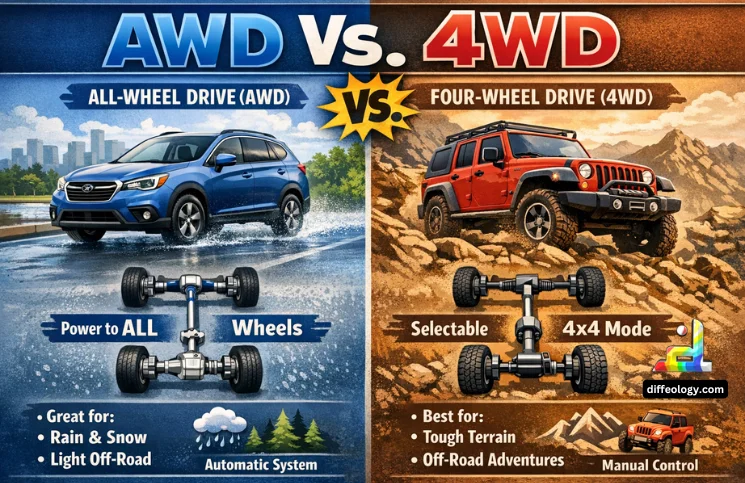
The difference between Awd and 4Wd will be explained here. Power goes automatically to every wheel with AWD, useful when roads are slick, snowy, or bumpy. When thick muck, rugged terrain, tough pulls, or sharp slopes show up, 4WD steps in – tougher, switched on only when needed
Main Difference Between AWD and 4WD
A vehicle’s purpose shapes whether it uses one system or the other. On slippery streets, automatic grip comes alive silently, needing nothing from the person behind the wheel. Built for mud, rocks, or towing, another type waits patiently until called upon by hand. Daily rides often carry a setup hidden under smooth surfaces, ready when weather turns. Rugged frames favor brute strength, waking only when chosen. Cars glide through city life with unseen help. Trucks stand firm where paths disappear.
AWD Vs. 4WD
What is AWD
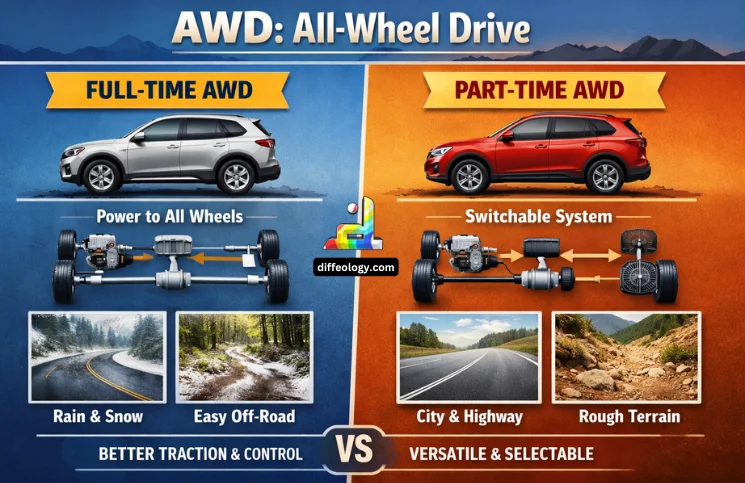
Power goes to every wheel when a vehicle has all-wheel drive, also known as AWD. What helps manage this? Components such as a center differential plus systems that shift force between wheels. Slippage gets noticed by sensors while electronics redirect energy where there’s still hold. Some models keep power flowing constantly to all corners of the car. Others wait – running just two wheels until one starts spinning too fast. Once detected, extra effort is made to get whichever tires can catch pavement again. Drivers often feel more confident during wet weather or early winter dustings. The switch happens behind the scenes, requiring nothing from those behind the steering wheel. No buttons, no decisions – it adjusts itself before most notice trouble.
- Key technologies: center differential; torque vectoring; clutch packs; viscous coupling; traction control; electronic stability control.
- Simple facts: AWD is common on many sedans and crossovers; it helps reduce wheel slip and makes the car feel steady in bad weather.
Read Also: Difference Between Steel and Alloy Wheels
Finding your way through rain-slicked streets? AWD handles it without fuss. No switches to toggle, no delays. Power moves where traction slips, almost silently. When snow dusts the pavement thin, grip improves just enough. Roads turn slick – control stays steady. A bit heavier. A touch more fuel needed than two-wheel drive. Yet grip matters most when roads turn slick. Some find that balance fair. Worth it when traction fades.
What is 4WD
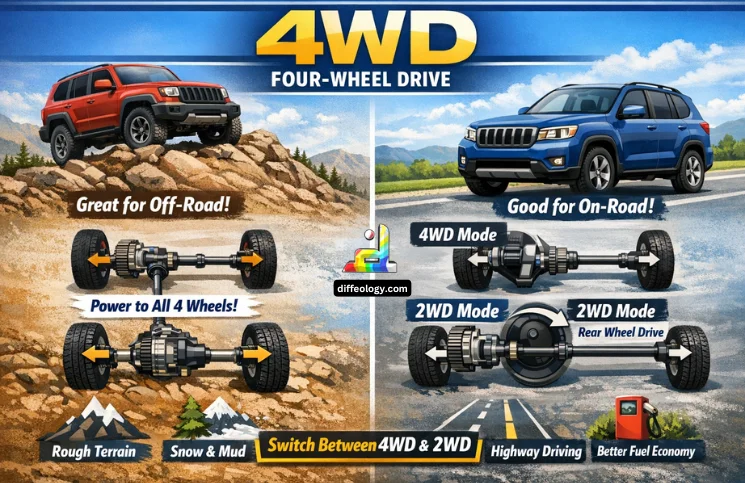
Starting off, four-wheel drive – also known as 4WD – is made for tough jobs and rough terrain. Built into it are things like a transfer case, a locking differential, a low-range gearbox, plus now and then a limited-slip differential. With these, power can go evenly to both front and back wheels when needed. A lower gear setting boosts pulling strength while moving slowly. Sometimes you’ll find 4WD High, useful on bumpy roads without slowing down too much. Then there’s 4WD Low, better suited for crawling up hills or dragging through thick mud.
- Key technologies: transfer case; locking differential; low‑range gearbox; limited‑slip differential; traction control.
- Simple facts: 4WD is common on trucks and off‑road SUVs; it is best for deep snow, mud, sand, rocks, and steep hills.
Read Also: Difference Between Diesel and Petrol Engine
Most times, a person has to switch on four-wheel drive by hand. When trails get bumpy or grip feels low, that is when it kicks in. Running it on regular streets might hurt the system and make turns feel stiff. Heavier build comes from the added pieces under the car, uses more gas too – yet when mud, snow, or steep ground shows up, it holds the vehicle steady.
Comparison Table “AWD Vs. 4WD”
| Typical use | Road grip | Off‑road |
| Engagement | Automatic | Selectable |
| Low range | No | Yes |
| Weight | Lower | Higher |
| Fuel economy | Better | Lower |
Difference Between AWD and 4WD in Detail
Get to know the Difference Between AWD Vs. 4WD in Detail.
Purpose and Use
AWD is made to help on normal roads that get wet or icy. It gives steady grip so the car feels safer. 4WD is made for rough ground and heavy work. It gives strong traction for off‑road driving and towing.
AWD is best for daily driving in rain or light snow. 4WD is best for trails, farms, and places with deep mud or snow.
How They Engage
AWD uses sensors and small clutches or a center differential to move power where it is needed. It acts by itself and the driver does not need to do anything. 4WD uses a transfer case and often a lever or switch to lock axles or pick low range. The driver chooses the mode.
AWD is automatic and quick. 4WD is selectable and gives the driver more control when needed.
Torque and Power Flow
AWD can use torque vectoring to send more power to one wheel or one axle for better handling. This helps in turns and on slippery roads. 4WD can lock axles so both front and rear wheels turn together for max traction.
AWD balances power for smooth driving. 4WD gives raw pulling power for hard places.
Low Range and Gearing
Most AWD systems do not have a low‑range gearbox. 4WD systems often do. Low range gives much more torque at low speed. This helps climb steep hills or pull heavy loads slowly.
If you need slow, strong power, 4WD low range is the tool to use. AWD cannot match that.
Weight and Fuel Use
AWD adds some weight and uses a bit more fuel than two‑wheel drive. 4WD adds more weight and usually lowers fuel economy more than AWD. The extra parts in 4WD make the vehicle heavier.
If you want better fuel use, AWD is often the better choice. If you need strength, accept the extra weight of 4WD.
Complexity and Cost
4WD systems are often more complex and cost more to buy and to fix. Parts like the transfer case and locking differential add cost. AWD systems are simpler and often cheaper to maintain.
If you want a low‑cost, low‑care option, AWD is easier. If you need heavy duty, be ready for a higher cost with 4WD.
Driver Skill and Safety
AWD helps drivers who are not experts. It works by itself and makes driving in rain or light snow easier. 4WD gives more control but needs the driver to know how and when to use 4WD High and 4WD Low and when to lock differentials.
For most city drivers, AWD is safer and simpler. For off‑road drivers, 4WD gives the tools needed for tough terrain.
Key Difference Between AWD and 4WD
Here are the key points showing the Difference Between AWD Vs. 4WD.
- Purpose: AWD for road grip; 4WD for off‑road power.
- Engagement: AWD automatic; 4WD selectable.
- Low range: AWD no; 4WD often yes.
- Weight: AWD lighter; 4WD heavier.
- Fuel: AWD better economy; 4WD worse.
- Cost: AWD cheaper; 4WD costlier.
- Maintenance: AWD simpler; 4WD more parts.
- Vehicles: AWD cars; 4WD trucks.
- Traction control: AWD electronic; 4WD mechanical options.
- Towing: 4WD better on rough ground.
- Snow use: AWD good for light snow; 4WD for deep snow.
- Driver input: AWD none; 4WD some.
- Off‑road features: 4WD often has skid plates, locking diffs.
- Everyday use: AWD is more user‑friendly for city drivers.
FAQs: AWD Vs. 4WD
Conclusion
AWD is an automatic system that helps most drivers on wet roads and light snow without any action from the driver, using parts like center differential, torque vectoring, clutch packs, viscous coupling, traction control, and electronic stability control, while 4WD is a stronger, selectable system with parts like transfer case, locking differential, low‑range gearbox, and limited‑slip differential that you use for hard off‑road work and heavy towing; pick AWD for easy, safe daily driving and 4WD when you need real off‑road power and control. Now you know the Difference Between Awd and 4Wd so buy wisely.

