

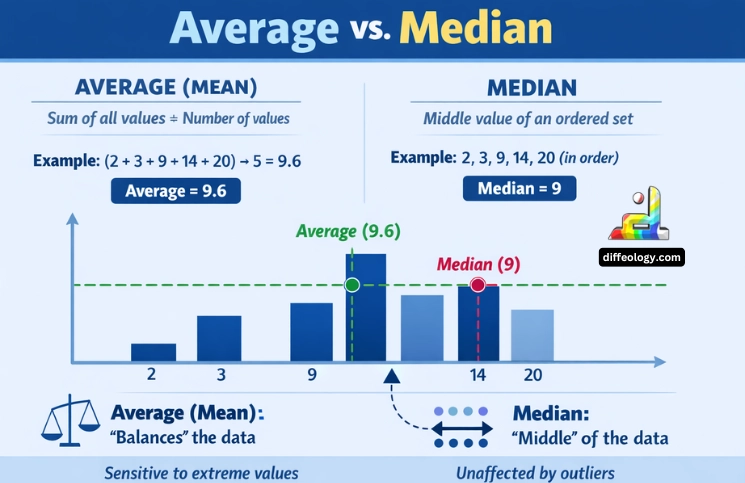
The difference between average and median is easy. It is about two easy ways to get at the center of a set of integers. Average counts all of the numbers and divides by the total there are. The median arranges the numbers and chooses the middle one. For instance, should five individuals earn $10, $12, $15, $18, and $1,000, the median is $15 and the average becomes $211.One very big number can raise the mean, but the median stays near the center.
This handbook makes selecting the appropriate measure for your data possible with simple language and examples.
Main Difference Between Average and Median
The fundamental distinction is how every number is handled by each measure. Adding and dividing produces the average’s balance point using every value. The median arranges and provides the median value after sorting. The mean will fluctuate a lot if one value is either exceedingly large or quite little; the median will not change much. Median for a list of 9 scores is the fifth score after sorting; average is the sum divided by 9.The average applies for consistent, well-balanced data; the median is for a few extreme values that would give a misperception.
Average Vs. Median
What is Average

The number you derive by summing all the values and dividing by how many values there are is known as the average or mean. Average is ((2 + 4 + 6) divided by 3 = 4 if three friends have 2, 4, and 6 apples. The average presents one figure which sums up the entire group. Many tools—Excel, Python, and R among them—make simple to use.
- Formula: sum of values ÷ number of values.
- Example: For 5 numbers 10, 12, 15, 18, 1000, the average is \((10 + 12 + 15 + 18 + 1000) ÷ 5 = 211.
- Tools: Excel; Python; R; SQL; Google Sheets.
Read Also: Difference Between Mean and Median
The average is used in science, business, and many apps. It works well when numbers are spread evenly. But if a few numbers are very large or very small, the average can give a wrong idea of what is normal.
When people use average
- To find the mean score on a test.
- To find average speed or temperature.
- To calculate simple budgets or costs.
What is Median
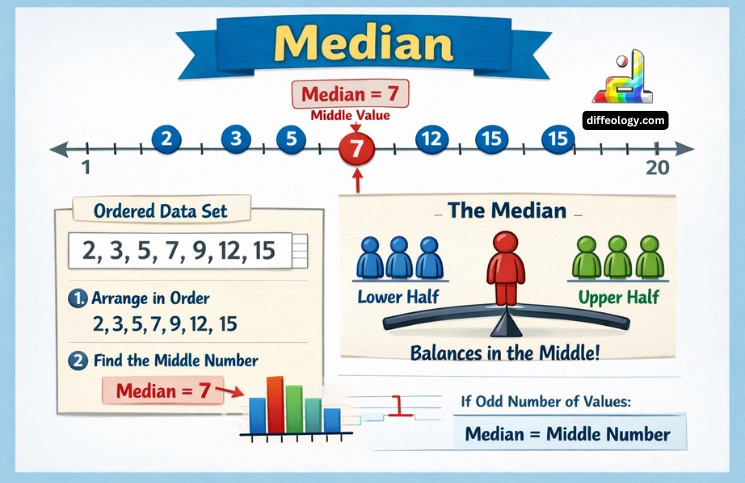
The median is the middle value in a list after you sort the list from smallest to largest. If the list has an odd number of items, the median is the single middle item. If the list has an even number of items, the median is the average of the two middle items. For example, for 4, 7, 9, 20, the median is \((7 + 9) ÷ 2 = 8. The median shows the middle case and is not pulled by very large or very small numbers.
- Example: For incomes $20,000, $25,000, $30,000, $1,000,000, the median is between $25,000 and $30,000, so the median is \(($25,000 + $30,000) ÷ 2 = $27,500.
- Tools: Excel; Python; R; SQL; Google Sheets.
Read Also: Difference Between Rational and Irrational Numbers
The median is often used for wages, house prices, and other data with a few very large values. It gives a better sense of what a typical person has or pays.
When people use median
- To report typical income or house price.
- To show a typical value when outliers exist.
- To describe the middle of a ranked list.
Comparison Table “Average (Mean) Vs. Median”
| Definition | Sum ÷ count | Middle value after sorting |
| Affected by outliers? | Yes | No |
| Best for | Symmetric data | Skewed data |
| Common use | Science, models | Income, house prices |
| Calculation | Add and divide | Sort and pick middle |
Difference Between Average and Median in Detail
Get to know the Difference Between Average Vs. Median in Detail.
1. How they are found
The average is found by adding all numbers and dividing by the count. The median is found by sorting the numbers and picking the middle one. The average needs every value; the median needs order.
The average changes if any value changes. The median changes only if the order near the middle changes. This makes the median steady when a few numbers are extreme.
2. Effect of outliers
The average is sensitive to outliers. One very large or very small number can move the average a lot. The median is robust to outliers and stays near the center.
For example, in a set of 5 numbers where four are around 20 and one is 1000, the average will be much higher than 20, but the median will still be near 20.
3. Use in reports
The average is common in science and engineering where data are symmetric. The median is common in social reports like income and house price reports where data are skewed.
Governments often report median income to show what a typical household earns, because a few very rich households would raise the average too much.
4. Math and formulas
The average has algebra rules that make it useful in formulas. It works with variance and standard deviation. The median does not combine in the same linear way and is less used in algebraic formulas.
Because of its math properties, the average is used in many models and in tools like SPSS and Tableau for calculations.
5. Ease of explanation
The median is easy to explain as the middle value. The average needs the idea of sum and division, which some people find less direct.
Teachers often show both with small examples so students can see how each works.
6. Even and odd counts
When the count is odd, the median is a single number. When the count is even, the median is the mean of the two middle numbers. The average always gives one number, even if the result is not an integer.
This means the median can be a fraction even when all data are whole numbers.
7. Best practice
Good practice is to show both average and median when you can. If they are close, the data are likely symmetric. If they are far apart, the data are skewed and the median may be a better choice.
A big gap between average and median is a sign that outliers or skewness are present.
Key Difference Between Average and Median
Here are the key points showing the Difference Between Average Vs. Median.
Definition: Average = sum ÷ count; median = middle after sorting. The average uses all values; the median uses order and the center.
Outliers: Average is affected; median is not much affected. A single extreme value can change the average a lot but not the median.
Best use: Average for balanced data; median for skewed data. Use median for incomes and house prices.
Calculation: Average needs addition and division; median needs sorting. Sorting is the main step for median.
Even sets: Average always gives a number; median may be the mean of two middles. Median can be fractional for even counts.
Robustness: Median is more robust to extreme values. Robust means it resists change from a few odd numbers.
Reporting: Median is common in public reports on income. Average is common in lab and engineering reports.
Math use: Average fits many formulas; median does not fit linear formulas well. Average links to variance and standard deviation.
Interpretation: Average is a balance point; median is the middle person. Balance point means the sum of differences above and below is zero.
Missing data: Replacing missing values with average is common but can bias results. Median replacement can be better when data are skewed.
Skew detection: A large gap between average and median shows skew. If average > median, data are right-skewed; if average < median, left-skewed.
Sample size: Both need enough data to be useful. Small samples can give unstable averages and medians.
Computation: Average needs full sum; median needs sorting. Sorting can be done fast with tools like Python or SQL.
Communication: Median is often easier for the public to grasp. Average may need more explanation for non-technical readers.
FAQs: Average Vs. Median
Conclusion
When you explain numbers, pick the measure that fits the data: use the average for balanced sets and the median when a few extreme values would mislead; this rule about the difference between average and median helps readers know what “typical” really means.

