

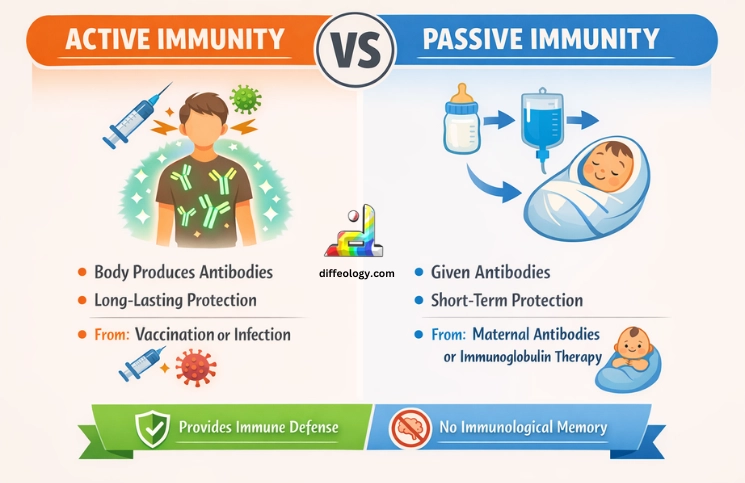
Active immunity and passive immunity are two methods by which the body is able to defend itself against diseases, and knowledge of these concepts aids students in comprehending the operation of the immune system in everyday life. The main difference between active and passive immunity is how antibodies enter the body and how long they protect the body.
Studies indicate that vaccines protect about 70, 95% of people from getting severe diseases. In passive immunity, the body is not involved in the production of antibodies. It is more like the situation when a mother gives her baby all the necessary antibodies or through the injection facilitated by Monoclonal Antibody Technology, where antibodies are directly supplied. The protection is very quick, usually within 24, 48 hours, but it is of a short duration, i.e. 2, 6 weeks.
These two kinds of immunities are being practiced in today’s medicine and thus, are instrumental in the saving of millions of lives every year, all over the globe.
Main Difference Between Active and Passive Immunity
In active immunity, the immune system produces antibodies without any help from outside. This is the result of a natural infection or a vaccination using a Vaccination Technology like mRNA Vaccines, Inactivated Vaccines, and Live Attenuated Vaccines. The body also creates memory cells that recognize the pathogen. For that reason, the protection remains for a very long time and is effective in 80, 90% of the people.
On the other hand, in passive immunity, antibodies are provided to the body directly through Immunoglobulin Therapy or Antiserum Technology. These antibodies are the first to work quickly but they are gradually removed from the body. As there are no memory cells being formed, the level of protection can become as low as 0% shortly after the administration.
Active Immunity Vs. Passive Immunity
What is Active Immunity
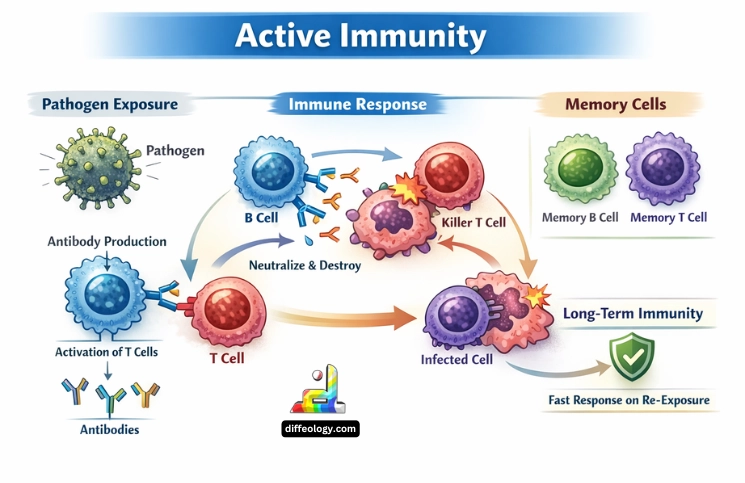
Health initiatives typically employ booster vaccinations to keep antibody levels high, therefore supporting active immunity is sustained. One or more doses are sometimes taken to provide adequate protection. The body keeps B cells and T cells able to react faster on later exposure; this quicker response lowers disease risk and slows down spread in a community. Immune strength is assessed by scientists depending on antibody levels and the quantity of memory cells. According to studies, the kind of vaccine, the pathogen, and the age and health of the individual define how long a response lasts.
Read Also: Difference Between Cold and Allergies
What is Passive Immunity
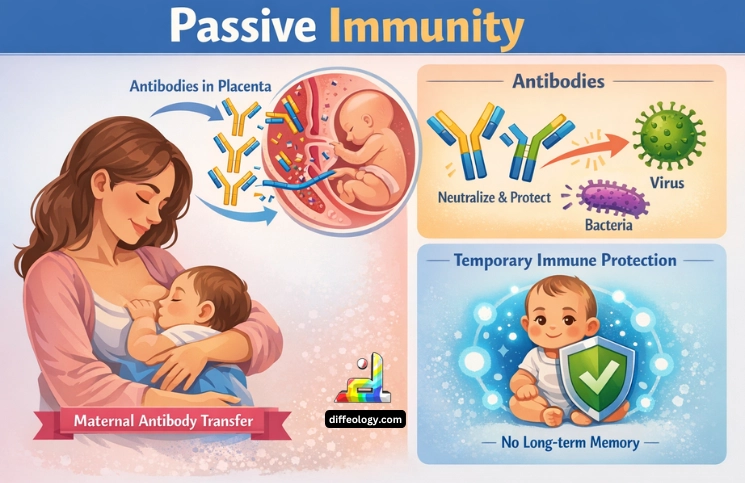
Passive immunity is when a baby gets antibodies from the mother through the placenta before birth and then through breast milk after birth. This gives the baby instant protection against some diseases. This protection usually lasts for three to six months because the baby’s own immune system is still developing. Doctors also provide immunoglobulins, antibody drugs, to people who need quick protection after they have been exposed to an illness. These injections work right away because they give the body antibodies that are already made. However, the body does not make memory cells from them.
Read Also: Difference Between Heart Attack and Cardiac Arrest
Comparison Table “Active Immunity Vs. Passive Immunity”
| Antibody source | Body makes its own | Given from outside |
| Time | 7–14 days | 24–48 hours |
| Duration | Years to life | Weeks |
| Memory cells | Present | Absent |
| Technology | Vaccines, mRNA Platforms | Antiserum, Monoclonal Antibodies |
| Cost | Lower by 50% | Higher |
| Use | Prevention | Emergency |
Difference Between Active and Passive Immunity in Detail
Get to know the Difference Between Active Vs. Passive Immunity in Detail.
1. Source of Antibodies
In active immunity, antibodies are made inside the body by immune cells after infection or vaccination using Vaccine Production Technology. Antibody levels rise slowly but remain strong for many years in 80–90% of people.
In passive immunity, antibodies come from outside sources. These sources include breast milk or injections made using Plasma-Derived Antibody Technology. These antibodies help right away but slowly disappear.
2. Speed of Action
Active immunity works slowly. The immune system needs 7–14 days to prepare antibodies. This is why vaccines are taken before exposure to disease.
Passive immunity works very fast. In emergency cases like snake bites, Antivenom Technology can reduce death risk by 90–95% within 24 hours.
3. Duration of Protection
Active immunity lasts for a long time because memory cells remain in the body. Some vaccines protect 97% of people for more than 20 years.
Passive immunity lasts a short time. Antibodies usually disappear within 3–6 weeks, and protection reduces quickly.
4. Immune Memory
Active immunity creates immune memory. When the same germ enters again, the immune system reacts 5–10 times faster.
Passive immunity does not create immune memory. Once antibodies are gone, the body has no stored defense.
5. Use in Medicine
Active immunity is mainly used to prevent disease through National Immunization Programs. These programs reduce disease spread by 70–90%.
Passive immunity is used in urgent cases such as rabies exposure using Rabies Immunoglobulin Technology.
6. Cost Over Time
Active immunity is cheaper in the long run. One or two doses can protect for many years and reduce healthcare costs by 50–60%.
Passive immunity needs repeated doses, which can raise costs by 2–3 times.
7. Examples
Examples of active immunity are polio, measles vaccines, and COVID, 19 vaccines made using an mRNA Vaccine Platform, which provides 85, 95% protection against severe illness.
Examples of passive immunity are antibodies transferred from the mother to the baby and injections produced using Monoclonal Antibody Technology.
Key Difference Between Active and Passive Immunity
Here are the key points showing the Difference Between Active Vs. Passive Immunity.
- Antibody Production
Active immunity makes antibodies inside the body. Passive immunity receives antibodies from outside. - Speed
Active immunity works in 7–14 days. Passive immunity works in 1–2 days. - Duration
Active immunity lasts years. Passive immunity lasts weeks. - Memory Cells
Active immunity forms memory cells. Passive immunity does not. - Vaccines
Active immunity uses vaccines with 70–95% success. - Emergency Use
Passive immunity gives quick help with 95% fast action. - Natural Way
Active immunity follows infection. Passive immunity occurs at birth. - Boosters
Active immunity may need boosters every 5–10 years. - Cost
Active immunity saves 50–60% long-term costs. - Allergy Risk
Passive immunity has 1–5% allergy risk. - Community Protection
Active immunity supports herd protection above 70% coverage. - Strength Over Time
Active immunity grows stronger with exposure. - Antibody Control
Passive immunity gives fixed antibody levels. - Examples
Vaccines and antibody injections show the contrast.
FAQs: Active Immunity Vs. Passive Immunity
Conclusion
People who understand the difference between active and passive immunity can better comprehend the reason why vaccines provide long, term protection, while antibody injections offer only short, term help. Additionally, they understand why both are necessary tools in modern medicine.
References & External Links
- Active Immunity Types Characteristics and Examples
- Passive Immunity Types Characteristics and Examples

